
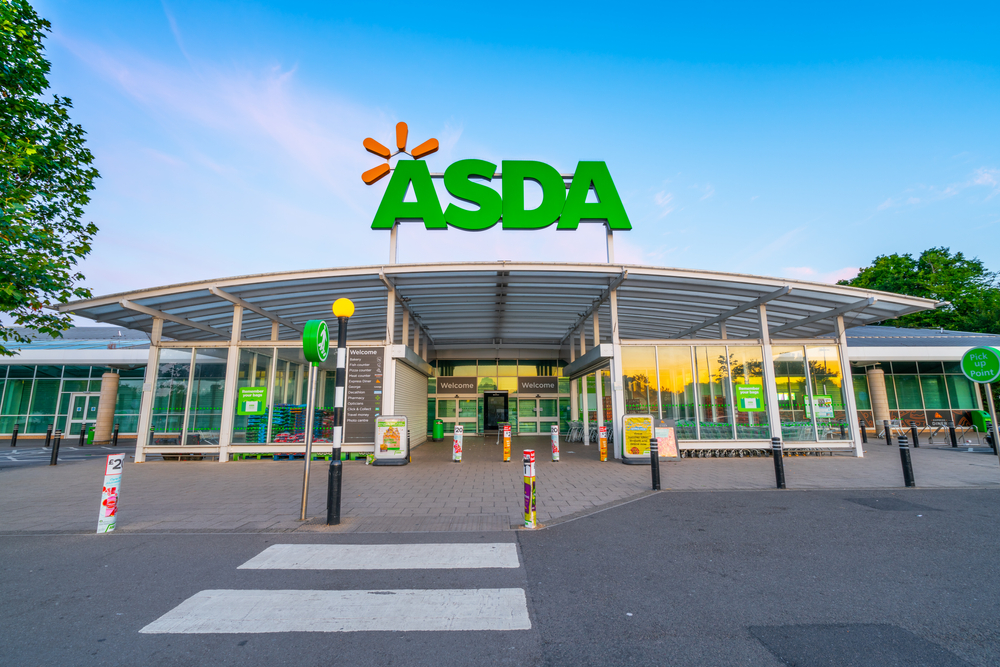

In the latest market analysis, Asda’s share has seen a significant decline. This development raises concerns for the retail giant.
Aldi, on the other hand, continues its upward trajectory, closing in on Asda and reshaping the competitive landscape.
Asda’s market share has fallen by nearly 1 percentage point over the past year, decreasing from 13.7% to 12.8%. This decline reflects ongoing struggles within the company, exacerbated by a 4% drop in sales over the last 12 weeks, according to Kantar data.
The dwindling market share highlights Asda’s challenges in retaining customer loyalty and adapting to the current market conditions.
Aldi’s revenue has increased by 0.8%, pushing its market share to 10.0%. This growth underscores its aggressive expansion strategy and competitive pricing model, which continue to attract a growing customer base.
Lidl, another discounter, has also strengthened its presence, seeing a 0.4 percentage point increase to 8.1% market share, driven by an 8.1% rise in sales. Lidl’s performance adds further pressure on traditional supermarkets.
Tesco has achieved its highest market share since February 2022, growing by 0.6 percentage points to 27.7%.
The company’s latest quarterly results show a 5.0% increase in food sales, particularly in fresh foods, indicating strong volume growth across the period.
Ocado has maintained its position as the fastest-growing grocer for the fourth consecutive month, with a 10.7% increase in sales during the 12 weeks to 9 June.
Online grocery shopping has gained traction, with nearly a quarter of British households making purchases online. Ocado’s market share now stands at 1.8%, up 0.1 percentage points from the previous year.
Recent data shows a mere 1.0% rise in take-home grocery sales industry-wide over the four weeks to 9 June, marking the slowest growth in two years. Adverse weather conditions and declining inflation have been significant factors.
Footfall has similarly stagnated, with the average shopper visiting supermarkets 16.3 times monthly, compared to 16.4 times the previous year.
Kantar’s Head of Retail and Consumer Insight, Fraser McKevitt, noted that the 2024 European Championship is expected to uplift the sector within the coming month.
McKevitt explained that promotions for beer and lager have surged, with over 40% of recent sales on promotion. This is a tactic to attract consumers who are enjoying the tournament.
Pubs may also see increased traffic and sales during the championship, following a similar trend from the 2021 tournament where food and non-alcoholic drink sales in pubs soared by 60% compared to the average month.
The competitive landscape of the UK grocery market is evolving, with discount retailers making significant strides.
Asda faces significant challenges to regain its market share amidst this fierce competition.

