
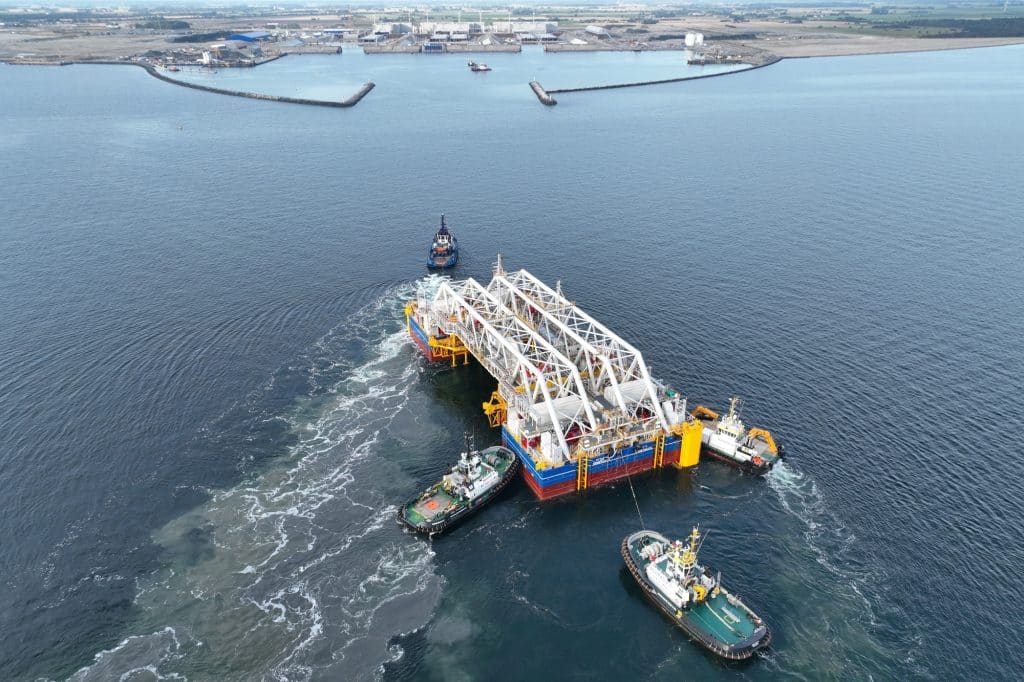

A specialised vessel critical to the Fehmarnbelt tunnel project between Germany and Denmark has reached its site, marking a pivotal development in the project’s progress.
- The Fehmarnbelt tunnel involves 217m long concrete elements being cast on Denmark’s island of Lolland, with 89 elements shaping the tunnel.
- A novel vessel, with components Ivy 1 and Ivy 2, has arrived to assist in immersing these heavy elements onto the seabed with precision.
- The immersion process involves adding ballast concrete to make elements heavy enough, aided by the two-ship vessel, ensuring accuracy in placement.
- Development on the technical equipment continues, with the vessel set for thorough testing before beginning element immersion.
The Fehmarnbelt tunnel project, which aims to connect Germany and Denmark, reached a significant milestone with the arrival of a specialised vessel designed to assist in immersing precast concrete elements. These elements, measuring 217m in length, are crucial to the construction of the 18km long tunnel. At the site in Rødbyhavn on the Danish island of Lolland, casting of these elements has been underway. The first element, which accommodates dual road and rail tubes, was completed in May 2024.
A noteworthy aspect of the tunnel construction involves 89 concrete elements, categorised into 79 ‘standard’ and 10 ‘special’ variations. The ‘special’ elements, distinct in their dimensions and weight, will be precisely positioned on the seabed. For this, the new vessel, which sailed from the Crist shipyard in Gdynia, Poland, will be instrumental. Known as Ivy 1 and Ivy 2, the vessel spans 105m in length and 45m in width when assembled. Its design ensures the elements are accurately placed with a precision of 12mm.
The construction process demands floating the elements post-casting into an 11m deep basin. Equipped with floatation gear, they are transported by tugboats to their designated underwater site. Prior to the immersion, additional ballast concrete is applied to each element, enabling them to sink as needed in the dredged trench. The process is executed with exacting precision, guided solely by the vessel’s pontoons referred to as ‘bathing wings’ to stabilise the immersion.
Throughout the immersion operation, the dual vessel configuration facilitates support for standard elements by positioning Ivy 1 and Ivy 2 at either end. For shorter, special elements, the vessel functions combined, optimising the immersion process. The vessel’s onboard system includes advanced winches and a control room, ensuring meticulous oversight of the immersion phases. Upcoming months will see the addition of further technical apparatus, with sea trials planned to ensure the vessel’s operational readiness.
Commenting on this intricate engineering task, Baris Nacar of Femern A/S remarked on the necessity for advanced equipment and skilled handling to achieve the required precision. Prior similar equipment included a multi-purpose pontoon for laying the tunnel’s gravel foundation earlier in the year, showcasing the project’s comprehensive approach to overcoming engineering challenges.
The arrival of the specialised vessel marks a crucial progression in the Fehmarnbelt tunnel’s construction, promising precision and efficiency in the element immersion process.
