
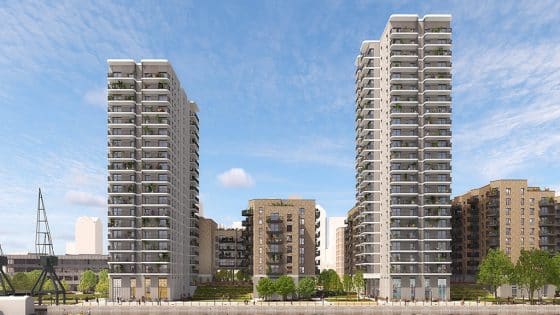

The £1bn redevelopment project for Westferry Printworks in London is poised for council approval after nearly a decade since its proposal.
- Tower Hamlets council officers have recommended conditional consent for the project, which is residential-focused with provisions for construction training and local labour.
- If greenlit, the development will feature 1,358 homes, a school, and commercial space across 13 buildings, with a significant commitment to affordable housing.
- The site’s planning has faced numerous revisions and political controversies, including high-profile approvals and legal challenges.
- The project has yet to meet some planning conditions, with ongoing discussions around public space and prefabrication methods.
The ambitious £1bn development plan for the rejuvenation of Westferry Printworks near Canary Wharf, London, is on the cusp of receiving formal approval from Tower Hamlets council. Officers within the council have advocated for a conditional approval, focusing on a residential-led project anchored on a vast 61,500 square metre site. Integral to this proposal are commitments to investing £652,000 in construction skills training and ensuring a workforce comprising 20 per cent local labour.
This development initiative, if approved, promises to bring about 1,358 homes, a secondary school capable of accommodating 1,200 students, and 6,200 square metres of commercial space. These structures will be housed across 13 buildings, varying in height from four to 31 storeys. Of the proposed housing, 379 units are earmarked as affordable, specifically 259 units for affordable rent and 120 units for intermediate rent.
The journey towards approval has been lengthy and fraught with complexities. Initially, in 2015, the site saw its first planning proposal. An endorsement from Boris Johnson, then Mayor of London, sanctioned the initial construct of 770 homes in four towers by 2016. Yet, the evolution of this project was not without contention. A fresh submission in 2018 expanded the vision to include an additional tower and a total of 1,524 homes. This iteration gained approval in 2020 under Housing Minister Robert Jenrick, which, however, became embroiled in controversy following Northern & Shell’s political donation and subsequent legal contestations that annulled the permission in High Court.
Ongoing consultation reveals that not all planning conditions have been met, particularly concerning play space provision. The Greater London Authority, alongside other consultees, highlighted deficiencies such as the shortfall in planned play areas, where the proposal offered 4,759 square metres against a target of 5,538 square metres. However, supplementary plans for a sports pitch and a multi-use games area have been deemed acceptable. Moreover, there is exploration into innovative building solutions, such as prefabrication techniques.
While the development manager, Mace, continues to spearhead project management, the main contractor remains unselected. Building safety considerations have not been overlooked; every edifice is to include at minimum two escape stairs and a firefighting shaft. The aim for commencement of construction is set within the year, projected over an anticipated timeline of seven years and four phases.
As Tower Hamlets council deliberates on approval, the Westferry Printworks redevelopment stands as a significant urban renewal endeavour fraught with both opportunities and challenges.

