
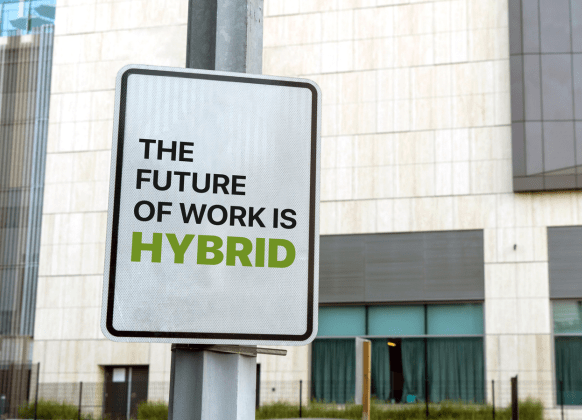

In response to economic pressures, CEOs are increasingly embracing hybrid working models to reduce operational costs.
- Recent data reveals a rise in suburban and commuter town office attendance, indicating a shift towards localised working environments.
- A significant 24% of businesses are reducing city centre office spaces in favour of flexible hybrid work arrangements.
- The popularity of hybrid working is reflected in the lower expectations for employees to be in city centre offices more than three days a week.
- The trend is supported by the belief that hybrid work improves employee wellbeing and business resilience during challenging economic conditions.
In the face of recession, business leaders are turning to hybrid working to mitigate costs, as indicated by recent data showing increased footfall in suburban and commuter town office spaces. A survey of more than 500 UK business leaders found that 24% have reduced their city centre office footprint, opting instead for more flexible, localised working arrangements.
This shift in working patterns coincides with a measurable rise in the use of local office workspaces. IWG’s analysis of annual office attendance from over 300 UK locations shows a clear trend towards greater utilisation of workspaces outside traditional city centres. Notably, former commuter towns such as Cambridge, Leatherhead, and High Wycombe have experienced substantial increases in demand, with footfall soaring by 112%, 67%, and 59% respectively.
The data further reveals a change in in-person collaboration patterns, with Wednesday and Thursday now preferred for office attendance, highlighting the evolving nature of workplace routines. This adjustment is complemented by broader expectations that a shorter working week may soon become standard practice, as business leaders recognise the changing dynamics of workforce management.
Despite a contraction in the UK economy towards the end of 2023 and ongoing economic challenges anticipated in 2024, a majority of CEOs, approximately 74%, remain optimistic about growth. Simultaneously, 65% of these leaders are strategically cutting costs to fuel expected growth, a move seen as essential to navigating the prevailing economic landscape.
To support the burgeoning demand for local office environments, over 800 new locations were added to IWG’s global network in 2023, predominantly in suburban and rural areas. This expansion underscores the growing necessity for hybrid working solutions that enable employees to combine the benefits of in-office collaboration with the convenience of reduced commuting.
Hybrid working emerges as a strategic approach for businesses navigating economic uncertainty while enhancing employee wellbeing.
