
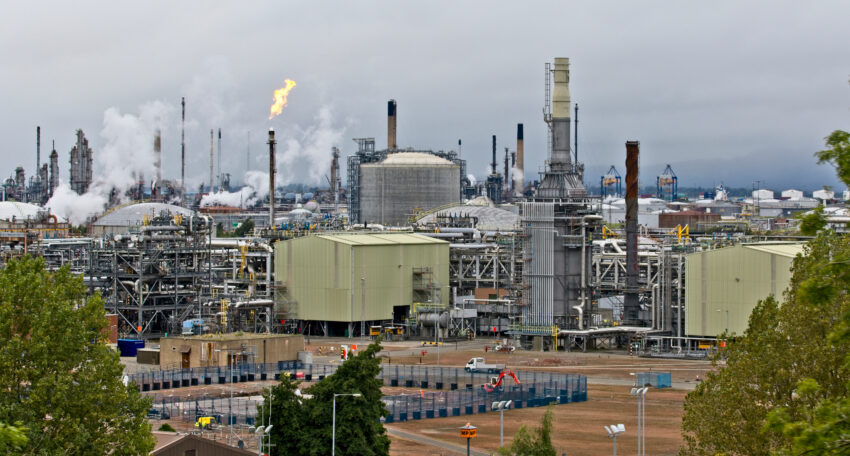

Scotland’s last oil refinery at Grangemouth is poised to shut down next year, leading to significant job losses and increased fuel imports for the UK.
The closure, driven by diminished demand for motor fuels, underscores a broader shift in the energy landscape, raising concerns over economic repercussions and future site utilisation.
Reasons Behind the Closure
The closure, announced by Petroineos—a joint venture between Sir Jim Ratcliffe’s Ineos and PetroChina—reflects declining domestic demand for motor fuels. This decline is exacerbated by the forthcoming ban on new petrol and diesel cars.
Frank Demay, Chief Executive at Petroineos Refining, highlighted the diminishing market: ‘With a ban on new petrol and diesel cars due to come into force within the next decade, we foresee that the market for those fuels will shrink.’ The decision also stems from the high costs of maintaining a refinery built nearly a century ago.
Impact on Employment and Community
Grangemouth currently contributes about 14% of the UK’s overall refining capacity. The closure will result in the direct loss of 400 jobs.
Approximately 75 workers will remain to manage a new import and export fuel terminal, while up to 280 jobs will be lost within three months post-closure. An additional 100 employees will stay on for up to a year to begin the decommissioning process.
Political and Union Reactions
The announcement has sparked criticism from political leaders and unions.
UK Energy Secretary Ed Miliband expressed deep disappointment, and his Scottish counterpart, Gillian Martin, along with union leaders, condemned the move as ‘industrial vandalism.’
Sharon Graham, General Secretary of the Unite union, criticised both Petroineos and politicians: ‘This dedicated workforce has been let down by Petroineos and by the politicians in Westminster and Holyrood who have failed to guarantee production until alternative jobs are in place.’
Economic and Supply Chain Effects
The UK remains a net exporter of petrol but relies on imports for diesel and jet fuel. The closure will further increase the nation’s dependency on imported fuels, impacting the broader economy.
Hisashi Kuboyama from the Federation of Small Businesses in Scotland warned about the wider consequences: ‘The knock-on effect on the supply chain will have an impact on numerous small businesses across the length and breadth of the country, putting many more jobs than the 400 on site at risk.’
Future Uses for Grangemouth Site
Studies commissioned by the UK and Scottish governments are exploring potential future uses for the refinery site, including hydrogen, biofuels, and sustainable aviation fuel.
However, these alternatives are unlikely to be operational before the refinery closes, necessitating further planning and investment.
A joint investment plan of £20 million has been announced, supplementing the previously declared £80 million Falkirk and Grangemouth Growth Deal, aiming to fund new growth projects in the area.
Financial Challenges and Investment Plans
The refinery has faced ongoing financial difficulties, with accumulated losses of $775 million since 2011 despite a $1.2 billion investment.
Its aging infrastructure, originally opened in 1924, is less efficient than that of overseas competitors and would require an additional £40 million to remain operational beyond next spring.
Broader Energy Landscape Implications
The closure signifies a significant shift in the UK’s energy landscape and raises questions about the future of the site and the community dependent on it.
The Grangemouth refinery closure will have profound implications, from job losses to increased reliance on fuel imports.
The transition will demand strategic investments and robust planning to mitigate its economic impact and explore viable future uses for the site.
