
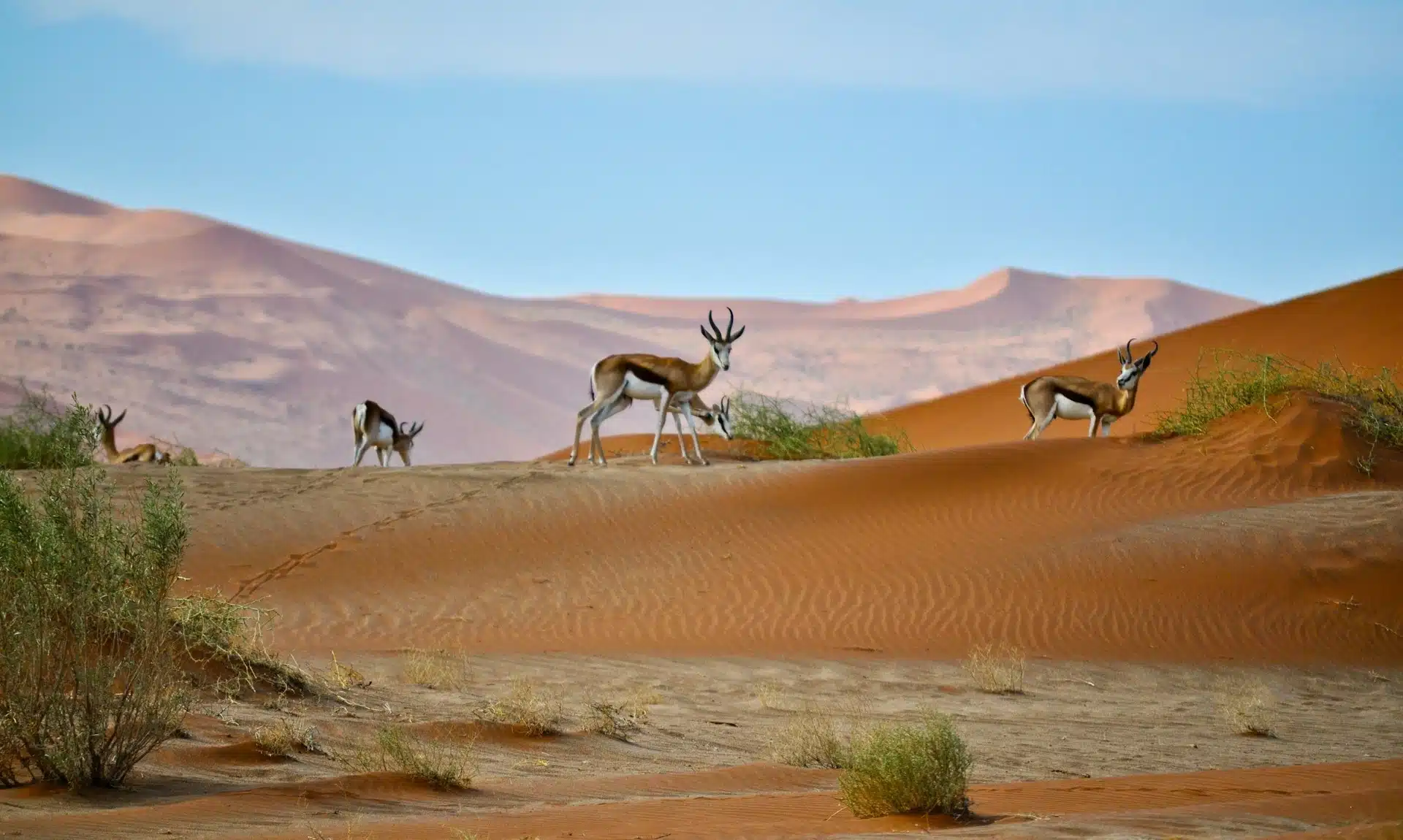

Namibia trips aren’t for the faint-hearted traveller. You’re signing up for long-haul flights, likely a connection or two, and serious time-zone adjustment. But some destinations are worth every minute of discomfort — and Namibia sits at the top of that list. The moment you land and the scale of this place starts to register, the journey simply stops mattering.
Standing Inside the World’s Oldest Desert
The Namib has been arid for roughly 55 million years. That number means nothing until you’re standing at Sossusvlei, staring up at dunes that stretch past 300 metres.
Dune 45 draws early risers at sunrise — and for good reason. The sand burns orange and red against a sky that genuinely has no business being that blue. The silence is the kind that makes you hold your breath. Wind moves across the ridgeline; nothing else does.
Then there’s Deadvlei. Camel thorn trees, dead for 600 years, stand on a white clay pan like something a set designer dreamed up. Rust-coloured dunes press in from all sides. Photographers fly across the world for this single spot. Within minutes of arriving, you’ll stop wondering why.
Desert Elephants in Damaraland
Here’s where Namibia gets genuinely surprising. In Damaraland’s rocky, stripped-back terrain — not exactly savanna country — elephants thrive. They’ve adapted: longer legs, larger feet, the ability to travel extraordinary distances between water sources.
Tracking them with a local guide through ancient rock formations feels less like a game drive and more like watching evolution in slow motion. These aren’t the elephants you see in documentaries set in lush grasslands. They’re something else entirely.
Desert-adapted lions and black rhinos live here too. Watching a herd of elephants move against red rock at dusk — honestly, that image doesn’t leave you.
Africa’s Most Underrated Canyon
The Grand Canyon has better marketing. Fish River Canyon has the substance.
At 160 kilometres long, up to 27 kilometres wide, and plunging 550 metres in places, it’s a geological event more than a tourist attraction. Stand at the edge and watch ravens wheel through space that could swallow entire city blocks. The light shifts all day; the shadows reshape the canyon wall by wall.
The catch? Most people just look down from the viewpoints. The five-day hike along the canyon floor is considered one of Africa’s finest treks. Even if that’s not your thing, being there — just standing at the rim — is enough.
Time Spent with the Himba People
In Kaokoland, the semi-nomadic Himba have maintained their way of life for centuries. Not as a reconstruction. Not as a performance. As a living culture, properly intact.
Himba women apply a mixture of butter, ochre, and herbs to their skin and hair — protection against sun and insects, yes, but also something far more culturally significant. Guides help facilitate real conversations; the kind where you start questioning your own assumptions about land, community, and what a good life actually looks like.
These encounters don’t fit neatly into a travel itinerary. They tend to rearrange things in your head long after you’ve returned home.
The Skeleton Coast’s Strange, Unsettling Beauty
The name alone tells you something. Whale bones. Shipwrecks. Permanent ocean fog rolling in off the Atlantic. This is where desert meets sea — two extreme environments colliding in a landscape that looks like it was designed to remind you how small you are.
Seal colonies pack certain beaches by the hundreds of thousands. Rusting ship hulls sit half-buried in sand, monuments to the coast’s long history of swallowing vessels whole. The light here does strange things — muted and grey one moment, suddenly electric as the fog shifts.
When planning Namibia trips, don’t treat the Skeleton Coast as optional. It’s the piece of the country that tends to haunt people most; the thing they reach for when they’re trying to explain why Namibia is different.
Getting here takes time. That’s just true. But these five experiences are a fraction of what the country holds — vast space, resilient wildlife, ancient geology, cultures that offer genuine perspective. Some places are worth crossing the world for.
Namibia is absolutely one of them.
