

If you had asked a typical American investor in 2018 to name the most important company in the world, very few would have said Taiwan Semiconductor Manufacturing Company. The answer has nearly completely altered eight years later, with TSMC’s American Depositary Receipts trading at about $411 and the market capitalization close to $2.13 trillion. The foundry in Hsinchu is no longer a little-known supplier that sits behind Nvidia and Apple. These businesses can no longer function without it. For the time being, the market is behaving as though it is aware.
The rally’s numbers speak louder than words. With year-to-date gains of almost 39 percent and one-year returns close to 37 percent, TSMC is currently trading just short of its 52-week high of $420. Revenue for the first quarter of 2026 was 41% more than the same period the previous year, and the company anticipates a revenue growth of about 35% in the second quarter.
Gross margins, the truest measure of pricing power in this business, hit 66.2 percent in the first quarter, which is the kind of figure usually reserved for software companies, not for an enterprise that runs some of the most expensive industrial facilities ever built. Observing the accumulation of financial releases gives the impression that demand is more than just robust. It is tight structurally.
| TSMC (TSM) — Stock and Company Snapshot | Details |
|---|---|
| Ticker | TSM (ADR on NYSE) |
| Full Name | Taiwan Semiconductor Manufacturing Company |
| Current Price (May 11, 2026) | Approximately $411.68 |
| 52-Week Range | $176.47 to $420.00 |
| Market Capitalization | Approximately $2.13 trillion |
| Year-to-Date Return | Around 39% |
| One-Year Return | Around 37% |
| Q1 2026 Revenue Growth | 41% year-over-year |
| Q1 2026 Gross Margin | 66.2% |
| Q2 2026 Revenue Forecast | Approximately 35% growth |
| HPC Share of Revenue | 61% (high-performance computing/AI) |
| Dividend Yield | 0.85% (ex-dividend date March 16, 2026) |
| Analyst Sentiment | Buy/Outperform; some targets near $490 |
| Reference Data Source | NYSE TSM listing |
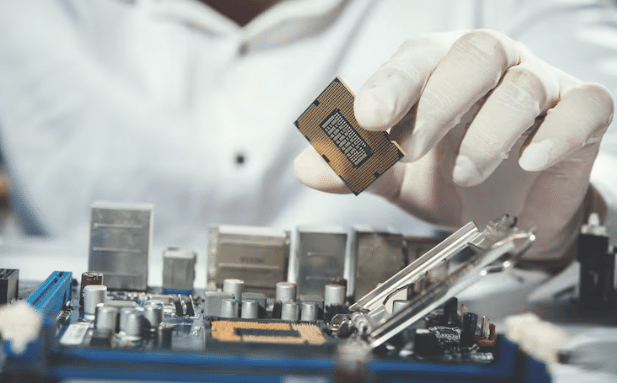
One segment of the clientele is responsible for the majority of such pressure. High-performance computing now accounts for 61 percent of TSMC’s revenue, an extraordinary concentration that effectively makes the company the supplier of the AI infrastructure build-out. Nvidia, AMD, Apple’s M-series and A-series chips, Broadcom’s custom silicon for cloud providers,
Google’s TPU iterations, almost all of them route through TSMC’s most advanced nodes. Anyone who has walked past a row of new data centres being built in Loudoun County or central Texas knows the demand is physical, not theoretical. Silicon, which originated in northern Taiwan, eventually fills each of those structures.
In general, the analytic community has kept up. A number of homes currently have price objectives close to $490, which would suggest significant improvement over current levels. However, the protest has raised its own concerns. Even though opinion was generally positive, a number of institutional investors have reduced their investments in recent quarters since a PE ratio of about 34 is no longer inexpensive by historical standards.
A stock that has performed this well in a little period of time is always surrounded with a familiar sense of unease. Regarding the second half of 2026, several experts have also expressed greater caution, pointing to possible tightness in the supply chain and the speed at which TSMC can increase capacity at the cutting edge.
Here, too, the geographic narrative is important. By building new facilities in Japan and increasing capacity in Arizona, TSMC has been consciously expanding its production footprint. The strategic reasoning is clear.
Every institutional investor has long been concerned about Taiwan’s geopolitical exposure, and part of the reason valuations have held up is the country’s gradual transition to a more globally dispersed footprint—even if it happens much more slowly than headlines suggest. The notion that the corporation will eventually decouple some risk from a specific island may also be subtly priced into the share price.
It’s difficult to ignore how all of this must be read by Taiwanese executives seated in Hsinchu. For many years, the company’s name appeared in supply chain footnotes as a sophisticated but unglamorous provider. These days, it is at the center of almost all significant industrial discussions, from European fabrication subsidies to American export restrictions.
The dividend, which is only 0.85 percent, is essentially meaningless. Investors appear to be holding TSMC for positioning reasons—the wager that, regardless of the outcome among AI software firms, the necessary chips will still go via a specific group of hands. The question that no one can definitively answer is whether that thesis endures the following economic cycle or whether rivals and capacity expansion eventually close the gap. For the time being, the run is still ongoing, and the stock continues to rise as it had for the majority of the previous year.
