

San Francisco, US, April 29th, 2026, FinanceWire
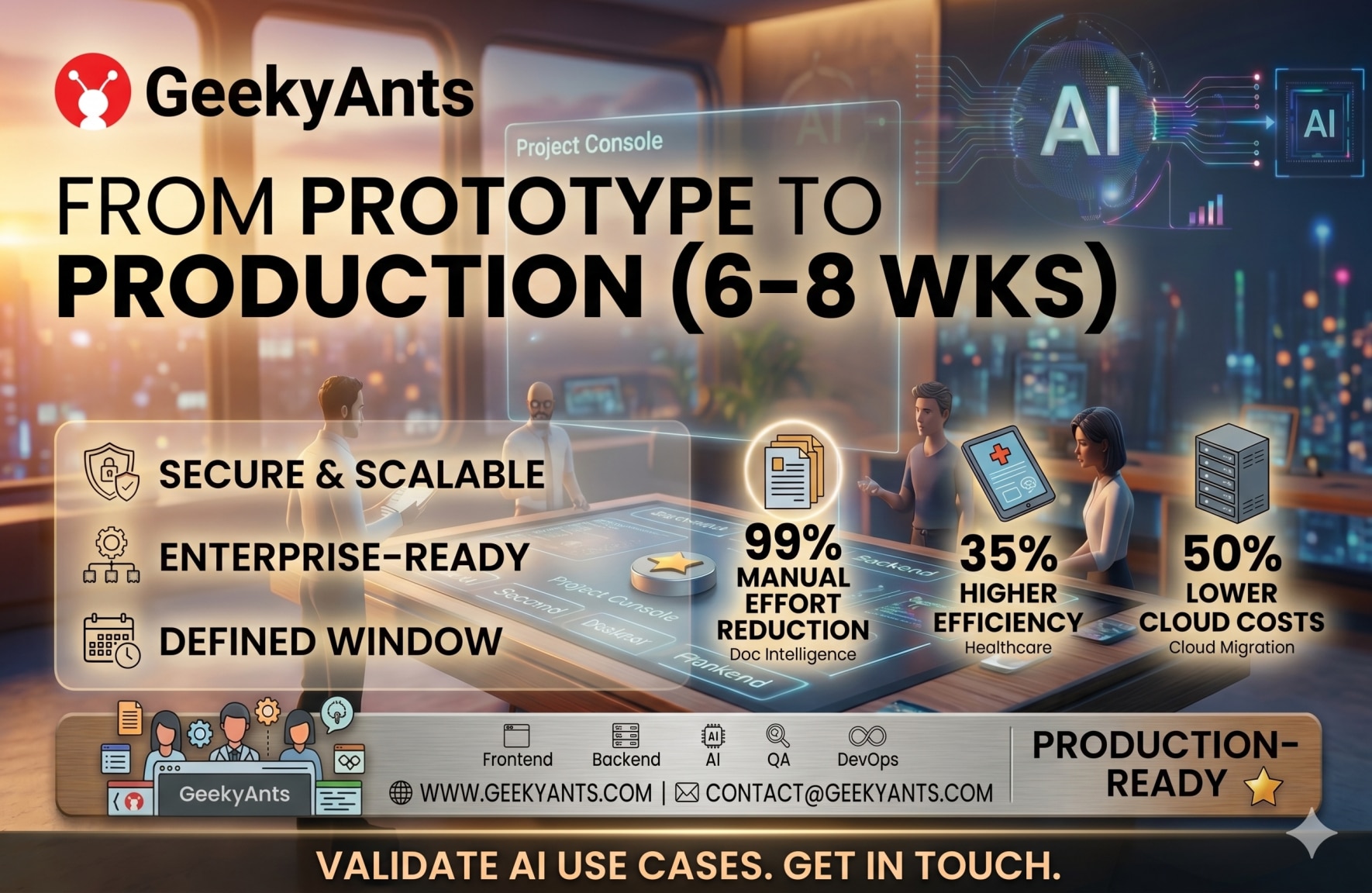
As enterprises move from AI pilots to production deployments, engineering teams face a harder challenge than model selection: turning prototypes into secure, scalable software that works inside complex business environments. GeekyAnts has introduced a 6–8 week AI Product Engineering Sprint for companies that need production-ready AI products within a defined delivery window.
The launch comes as enterprise AI adoption grows faster than enterprise AI maturity. McKinsey’s 2025 State of AI report found that 88% of surveyed organizations use AI in at least one business function, up from 78% a year earlier. Yet many companies still face a scaling gap between experimentation and enterprise-wide impact. The same report found that 62% of respondents had started experimenting with AI agents, while 23% had begun scaling agentic AI in at least one business function.
Those figures point to a practical constraint for large companies. Many teams can build AI demos, but fewer can move them through security reviews, infrastructure decisions, cost controls, testing, user workflows, and support models. For engineering and digital platform leaders, the challenge now centers on delivery discipline rather than AI awareness.
“The enterprise AI conversation has shifted from experimentation to delivery,” said Kumar Pratik, Founder and CEO of GeekyAnts. “Companies now need AI products that can meet security reviews, connect with existing systems, and perform under real usage. This sprint addresses that transition with engineering depth, clear scope, and production accountability.”
GeekyAnts says its sprint combines product strategy, full-stack engineering, AI integration, cloud deployment, quality assurance, observability, and handoff documentation. The company created the engagement for organizations that need to validate an AI use case, modernize a prototype, or build an AI-enabled product without committing to a long development cycle at the outset.
The sprint model can include frontend engineers, backend engineers, AI engineers, QA specialists, DevOps engineers, and product leadership. Depending on the scope, the engagement can cover application architecture, user experience, LLM or AI workflow integration, API development, cloud infrastructure, CI/CD pipelines, automated testing, monitoring, and launch preparation.
GeekyAnts’ published customer stories show how production engineering work has translated into measurable outcomes. In document intelligence, the company cites an AI-driven platform that reduced manual effort by 99%, processed 10,000 pages in about two minutes, and reached more than 85% response accuracy. In healthcare, it cites an AI clinical workflow automation platform that improved doctor efficiency by 35% and reduced onboarding time by 40%.
Other examples point to the infrastructure layer behind AI delivery. GeekyAnts reports that an AI-driven validation automation system reduced validation cycles by 50% and accelerated testing workflows by 30%. It also cites an AWS-to-Azure migration for an AI hiring platform that cut cloud costs by 50%, reduced mean time to recovery by 80%, and completed the transition with no unplanned downtime.
The offering reflects a broader change in enterprise software priorities. AI tools can accelerate prototype development, but they do not replace architecture decisions, governance, platform reliability, or customer experience design. Companies that operate across regulated markets, high-traffic digital platforms, or complex legacy environments need AI products that fit existing systems while meeting new expectations for speed.
For North American enterprises, that gap has become a leadership issue. VP-level technology leaders must balance pressure from boards, business units, and customer teams with the realities of cloud infrastructure, security standards, data access, and engineering capacity. For some organizations, a compressed sprint may offer a way to test an AI product path before wider investment.
The model does not remove the need for internal ownership. Buyers still need stakeholder access, data clarity, security alignment, and scope discipline. Legacy systems, regulated workflows, and fragmented data environments can still extend timelines or change implementation priorities. GeekyAnts’ sprint fits best when companies can define the problem, identify users, and provide enough technical access for production engineering work.
The announcement signals a clear market movement. Enterprise AI has entered a phase where prototypes alone carry less weight. Technology leaders now need software that can launch, scale, and operate under real business conditions.
About GeekyAnts Inc.
GeekyAnts is a Product development studio with an AI-driven, customer-centric approach. Our code is: Innovate, Collaborate. Build.
For more information, contact GeekyAnts Inc. at its U.S. office: 315 Montgomery Street, 9th & 10th Floors, San Francisco, CA 94104, USA. The company can be reached at +1 845 534 6825, info@geekyants.com, or through its website at www.geekyants.com/en-us.
Contact
Kumar Pratik
GeekyAnts
sponsorships@geekyants.com
