
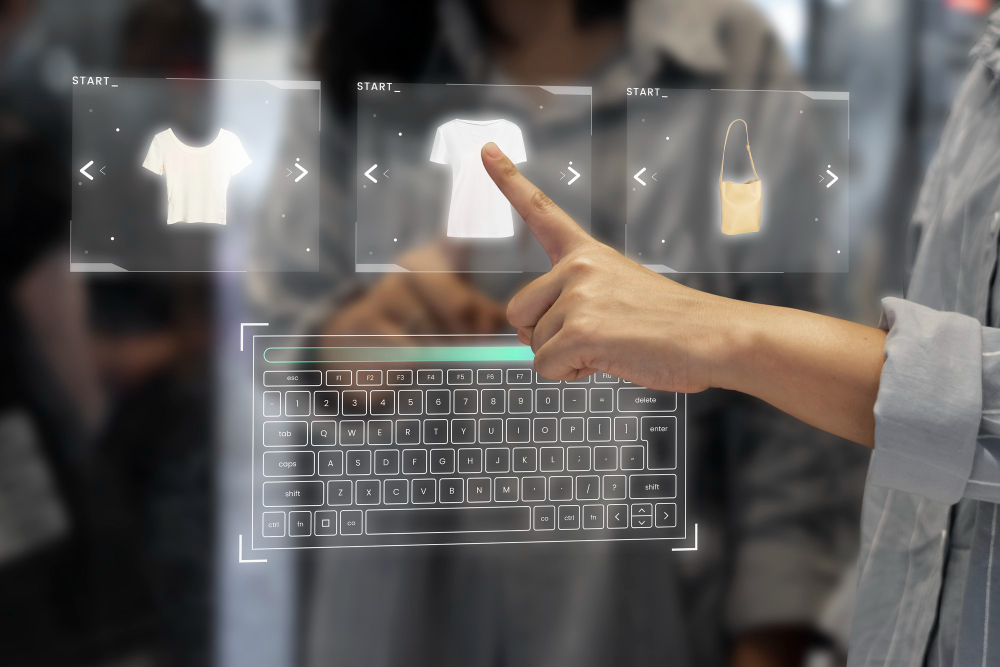

Anyone who has sold used clothing online is familiar with a certain type of frustration. You take a picture of the thing. You quantify it. You attempt to write a description that is both specific enough to draw in customers and not so specific as to ruin the search results. You look at a few similar listings, decide on a price based on what seems reasonable, and then you hope. After that, you wait. For days at a time. The friction is a feature that no one requested, and the entire process falls somewhere between a yard sale and a small business. Now, that experience is evolving more quickly than the majority of resale industry participants have had time to notice.
Instead of viewing this friction as a necessary expense of doing business in secondhand commerce, AI-driven marketplaces are starting to view it as a problem that can be solved. The change is significant because resale has always been more difficult than new retail because of the fragmented inventory, subjective condition, inconsistent sizing, and ongoing maintenance of trust between strangers. Conventional marketplaces such as eBay and Depop amassed massive user bases while essentially leaving those issues to be resolved by individual sellers. These days, machine learning is taking on the burden of navigation at the platform level and producing cleaner results on both ends.
| Category | Details |
|---|---|
| Topic Focus | AI Integration in Resale and Secondhand Marketplaces |
| Global E-commerce Market (Projected 2026) | $7.5–$8 trillion |
| Marketplace Share of E-commerce Growth | 60%+ of all e-commerce growth |
| Consumers Using AI to Shop | ~60% (Darden School of Business, 2025) |
| Consumers Willing to Let AI Make Purchases | ~1 in 3 U.S. consumers |
| Revenue Lift from Personalization Leaders | Up to 40% higher revenue |
| Key AI Marketplace Tools | Amazon Rufus, Zalando Assistant, Menura AI |
| Key Resale Platforms Referenced | Depop, Vinted, eBay, Poshmark |
| Retailers in Marketplace-Enabled Catalogs | 24% more likely to appear in AI agent results (Mirakl, Jan 2026) |
| Reference Website | ebay.com |
This equation’s consumer side is evolving quickly. Roughly 60% of consumers already use AI tools to help them make purchases, according to a 2025 study from the Darden School of Business. With just a few prompts, Amazon’s Rufus chatbot can cut through the clutter of thousands of listings by having customers describe what they want in a conversational manner. In order to provide fashion recommendations that act more like an informed friend than a search engine, Zalando’s AI assistant takes into account location, weather, and occasion. Although these are new retail applications, they are already having an impact on how customers anticipate interacting with any marketplace, including resale. Keyword search in a used app starts to feel almost antiquated after you’ve had the experience of frictionless product discovery.
What’s being built natively inside resale, as opposed to retrofitted onto it, is the more intriguing development. The traditional criticism of AI in resale has been that most platforms are applying machine learning to structures that were never intended for it, such as automated descriptions encasing data that sellers still manually entered or smarter search on top of manual listings. These days, some product thinkers and designers are suggesting even more: marketplaces that are constructed entirely around AI’s real capabilities. When a seller describes an item in natural language, the system takes care of taxonomy, classification, pricing advice, and even quality flagging from uploaded photos. When buyers describe their needs in simple terms, such as a waterproof jacket for a rainy commute or something formal but breathable for a summer wedding in Lisbon, they receive matched results that are pulled from various platforms, standardized, and surfaced into a single, cohesive feed. just one interface. No switching between platforms. Don’t search twice.
Sitting with that final section is worthwhile. The aggregation model, which uses AI to pull listings from Depop, Vinted, eBay, Poshmark, and brand-operated resale schemes, normalizes the data, and presents it as a cohesive experience, does more than just lessen buyer friction. It radically alters the resale market’s competitive advantage. Your listing quality, metadata, and trust signals are more important than your brand recognition or marketing budget if an AI agent is surfacing your inventory into a universal discovery layer and a buyer never needs to visit your platform directly. Retailers with marketplace-enabled catalogs show up in AI agent results 24% more frequently than those with conventional direct listings, according to a January 2026 report by Mirakl. That disparity will only get bigger.
For sellers, the pricing dimension is where things get especially interesting. Large platforms have long used dynamic pricing in new retail, which modifies prices in real time based on demand signals, competitor activity, inventory levels, and external factors like weather and local events. Applying that kind of pricing intelligence at scale has proven nearly impossible in resale, where each item is theoretically unique. By providing sellers with comparable transaction data, trend signals, and condition-adjusted pricing recommendations that previously required either in-depth category knowledge or laborious manual research, artificial intelligence significantly alters the calculus. It is not necessary for a Leeds vendor selling a vintage denim jacket to know what comparable items sold for in Berlin the previous week. The platform is able to determine that for them.
It’s difficult to ignore how similar this is to what happened to other retail categories with the introduction of data-driven platforms. Classified ads were disrupted by eBay. Independent retail was disrupted by Amazon. The hospitality industry was disrupted by Airbnb. The disruption followed a similar pattern each time: combine fragmented supply, lower demand friction, use data to enhance matching, and allow the established players to rush to catch up. The resale market, which accounts for a sizeable and expanding portion of total consumer spending and has a user base that is younger and more environmentally conscious than traditional retail, is currently in the early stages of that same process.
How the trust question changes as AI takes on more structural work in the marketplace is still genuinely unclear. Human cues, such as seller photos, response rates, review histories, and the specific way someone describes a defect in an item, have always been the foundation of resale. These cues convey information that is challenging to fully automate. A buyer wondering whether “good used condition” on a pair of sneakers means one careful owner or three rough winters is still making a decision that a rating system doesn’t fully resolve, even though an AI that standardizes condition language across thousands of listings is helpful. Even as the discovery and transaction layers become more machine-managed, developing trust at scale in secondhand commerce is still a human challenge.
As this industry changes, it seems likely that the platforms that approach AI as a basic redesign issue rather than a feature addition will determine what resale looks like in five years. Because younger consumers have normalized purchasing used goods as a first choice rather than a last resort, the secondhand economy has been steadily expanding. There’s no stopping that tailwind. A disproportionate amount of what comes next will go to the platforms that are intelligent enough to meet it with truly intelligent infrastructure rather than incrementally smarter search bars.
