
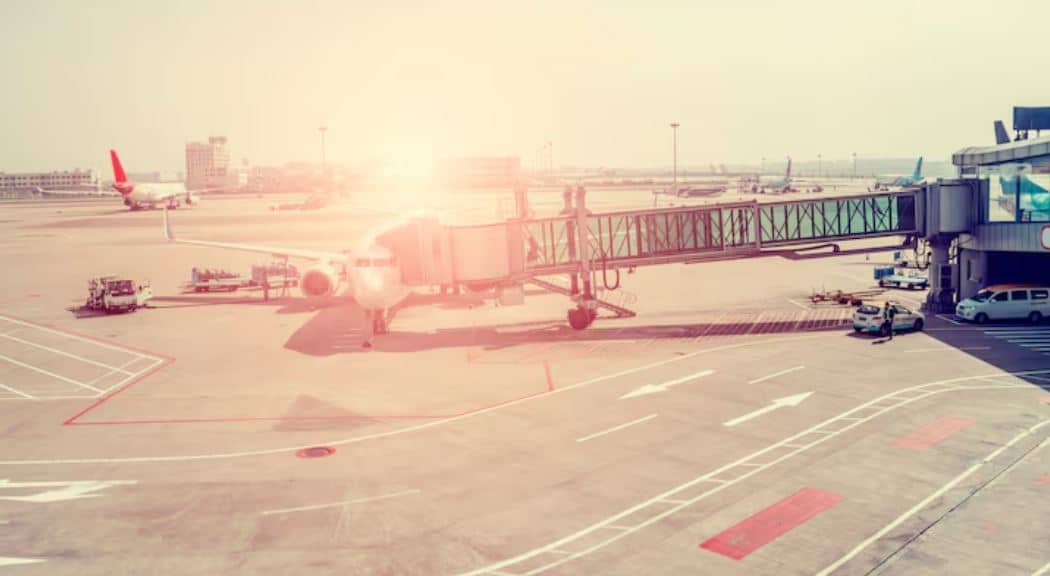

A darker column of smoke started to rise close to the edge of Dubai International Airport shortly after dawn, when Dubai’s sky is typically a clear, pale blue. It appeared almost industrial from a distance, like a flare from a refinery. It felt different up close. more sudden. less in control.
There were no more flights. Not gradually, but all at once. An Iranian-affiliated drone strike that morning that ignited a fuel tank close to one of the busiest airports in the world was more than just another story in a protracted regional conflict. A boundary seemed to have been crossed. Normally shielded from direct conflict, aviation had been abruptly drawn into the middle of it.
| Category | Details |
|---|---|
| Location | Dubai International Airport (DXB), UAE |
| Event | Drone strike linked to Iran conflict |
| Timeline | Ongoing Middle East war (Day 17 escalation) |
| Impact | Flight suspensions, diversions, fuel tank fire |
| Global Role | World’s busiest international passenger airport |
| Regional Effect | Airspace closures across Gulf countries |
| Economic Impact | Travel disruption, oil and logistics uncertainty |
| Casualties | No major injuries reported at airport incident |
| Reference | https://www.reuters.com |
The airport in Dubai is more than just infrastructure. It’s motion. A continual flow of people, languages, and places that link Africa to North America and Asia to Europe. It’s unnerving to watch it go silent, even for a moment. It resembles witnessing a major artery stop in the middle of a heartbeat.
Officials took swift action. Some flights were canceled, while others were rerouted to smaller airports like Al Maktoum. Passengers sat in groups inside terminals, scrolling through constantly shifting updates. That kind of uncertainty—information arriving instantly, clarity arriving slowly—has a very contemporary feel to it.
The incident wasn’t the first. In actuality, it was the third attack close to the airport since the conflict between Iran and its enemies grew more intense. Repetition is important. One incident can be written off as an anomaly. Three starts to resemble a pattern.
Iran may be more interested in signaling than in causing direct harm. Targeting commercial infrastructure, such as oil facilities and airports, has repercussions that extend well beyond the immediate explosion. Specifically, Dubai is a symbol of something greater than itself. stability. dependability. a location that felt immune to local unrest until recently.
That impression is starting to crumble. Airspace closures are now a common precaution throughout the Gulf. Missiles were intercepted. Drones were found. Early in the morning, when most people are still asleep, alerts are sent out. A civilian was reportedly killed in a different incident in Abu Dhabi. Oil facilities in Fujairah briefly caught fire before being put out.
Here, geography is important. One of the most important energy corridors in the world, the Strait of Hormuz, is located directly south of the United Arab Emirates. Fuel prices, shipping routes, and insurance costs all change almost instantly in response to any disruption in this area.
Airlines have already made the necessary adjustments. Travel times have increased as a result of some routes being extended to avoid specific airspaces. Others have received a complete suspension. There seems to be a slight but discernible bending of international aviation around the conflict.
It is initially felt by passengers. Now, a trip from London to Sydney may be rerouted, delayed, or unexpectedly grounded. A trip for business becomes uncertain. A holiday gets complicated. Together, these minor disturbances create a more comprehensive image of instability.
Nevertheless, Dubai persists. By the afternoon, Airport Road traffic had resumed its usual pattern. Shops reopened. Gradually, flights started up again. People carried shopping bags through air-conditioned hallways in malls all over the city, as though the morning’s events had taken place somewhere else.
It’s a startling contrast. Almost like a brand, Dubai has always exuded resilience. From the sand of the desert, skyscrapers rise. artificial islands with palm tree shapes. a city founded on the notion that it can surpass its surroundings. And it still does in a lot of ways. Restaurants start to fill up again. Hotels continue to be busy. Business is still going on.
However, the atmosphere has slightly changed. It’s difficult to ignore the heightened security presence and the sporadic pauses in conversation caused by news alerts flashing on screens. There is now a subtle awareness that staying away from conflict is no longer a given.
Investors are keeping a close eye on things. Dubai’s economy is largely dependent on its position as a global hub for travel, aviation, and logistics. These sectors could be affected by any prolonged disruption. Markets seem cautiously stable thus far, possibly placing a wager that things will level out.
There is a risk associated with that assumption. Conflicts in the area have historically fluctuated and occasionally escalated without warning. As the current conflict enters its third week, there is little indication that it will be resolved anytime soon. The strikes persist despite calls from political leaders for a de-escalation.
Whether Dubai’s infrastructure will continue to be a secondary target or take center stage in the conflict is still up in the air. What remains is that uncertainty.
Later that day, a sense of normalcy returns as one watches planes take off once more, their engines roaring against the waning light. However, it feels a little different. Maybe fragile.
Predictability—routes, schedules, and safety—is essential to aviation. The opposite is introduced by war.
And Dubai Airport is currently operating, adjusting, and waiting somewhere in between those two realities.
