
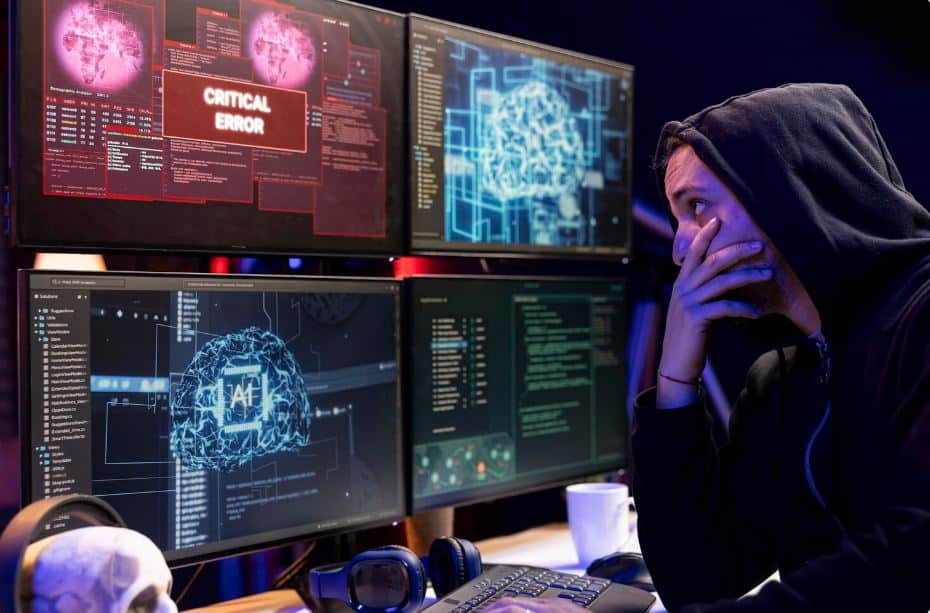

Thousands of workers at Stryker Corporation noticed something strange shortly after midnight on the U.S. East Coast. Telephones would not connect. Laptops wouldn’t start up correctly. Login screens displayed unfamiliar symbols and error messages that no IT department likes to see.
Many thought it was just another system outage for a short while. The scope of the issue then became evident. One of the biggest medical technology firms in the world, Stryker, experienced a cyberattack that affected its internal systems. Across several offices and regions, devices running Microsoft software—laptops, company-issued phones, and connected equipment—suddenly stopped functioning.
| Category | Information |
|---|---|
| Company | Stryker Corporation |
| Industry | Medical Technology & Healthcare Equipment |
| Headquarters | Portage, Michigan, United States |
| Employees | ~56,000 globally |
| Incident Date | March 11, 2026 |
| Nature of Attack | Cybersecurity breach disrupting Microsoft-based systems |
| Suspected Actors | Iran-linked hacker group “Handala” (claimed responsibility) |
| Impact | Global IT disruption affecting internal devices and operations |
| Reference Website | https://www.stryker.com |
It was reportedly tense but oddly quiet inside the company’s Portage, Michigan, headquarters. Employees were told not to access company systems. Employees were advised via emails to disconnect devices right away and steer clear of dubious links.
As events transpired from the outside, it became apparent how brittle contemporary corporate infrastructure can be. Businesses like Stryker run intricate digital ecosystems that connect hospital clients, manufacturing facilities, logistics networks, and research teams in dozens of nations.
Everywhere can be affected by a single breach. The attackers themselves seemed keen to take credit for their actions. The operation was described as retaliation related to wider geopolitical tensions in the Middle East by a group going by the name Handala, which cybersecurity analysts believe has connections to Iranian networks.
Even though it was challenging to confirm right away, that assertion gave what might have otherwise been just another corporate security incident a geopolitical component.
Cyberattacks are increasingly being used as weapons in international conflicts. These operations take place in silence, in contrast to conventional warfare. There are no explosions. There is no smoke rising over cities. Rather, the battlefield is a corporate network or server room that operates in silence behind office walls.
Employees arrive at work and find their systems wiped. Although Stryker stated there was no proof of ransomware or malicious software propagating into medical devices, the company acknowledged that the breach affected its Microsoft environment globally. That distinction is very important.
Every year, hospitals that treat millions of patients use Stryker’s products, which include robotic surgery platforms, orthopedic implants, and surgical instruments. A much more serious situation would probably arise if there was any sign that those systems had been compromised. That doesn’t seem to have occurred thus far.
However, the attack revealed weaknesses in a sector that has historically prioritized engineering accuracy over cybersecurity protection. Healthcare technology firms hold a special place. They supply goods that are deeply ingrained in hospital systems, but they function similarly to high-tech manufacturers. The repercussions can go well beyond corporate offices if their networks fail.
Whether the disruption was caused by a cyberattack or a logistical error is irrelevant to a hospital waiting for a shipment of surgical components. All they require is the equipment.
It’s hard not to notice how frequently healthcare companies have become targets for digital intrusions. In recent years, hospitals have experienced ransomware attacks, which have forced staff to either reroute emergency patients or return to handwritten patient records. Suppliers of medical technology now seem to be more vulnerable as well.
Over 50,000 people work for Stryker worldwide, and the company’s digital infrastructure supports everything from emergency response systems used by ambulance crews to robotic surgical planning.
According to some analysts, it’s possible that attackers obtained access through corporate device management systems and used their administrative privileges to simultaneously disable thousands of endpoints.
It would be a fairly sophisticated intrusion if that proved to be the case.
However, experts in cybersecurity often advise against making snap judgments. Attribution, or determining who was truly at fault, can take weeks or months, and early information following an attack is frequently insufficient.
Nevertheless, the overall point is already evident.
These days, corporate cybersecurity is more than just an IT problem. It is increasingly being incorporated into national security plans, especially when businesses are involved in critical infrastructure or public health. Concerns within government organizations in charge of homeland security can be promptly raised by a cyberattack against a medical supplier.
Although there are still few details available, Washington officials have reportedly started looking into the incident. Stryker has stated that it is working to gradually restore systems and that it thinks the disruption is under control. Once internal networks resume regular operations, orders placed prior to the incident should be shipped.
It’s unclear if consumers will experience long-term consequences. A delivery manager recently explained how much hospitals rely on consistent shipments while standing outside a medical equipment warehouse in the Midwest. Every day, pallets of replacement parts and surgical instruments pass through these buildings with little notice from the outside world.
People notice when that flow slows down. As the Stryker cyberattack develops, the healthcare industry is quietly realizing this. Physical machinery is no longer as important as digital infrastructure.
It is essential to hospitals. Manufacturers depend on it. Responders to emergencies also depend on it.
Furthermore, the ramifications of those unseen networks’ abrupt failure go well beyond the financial statements of a single business.
Engineers are probably still reviewing logs and reconstructing systems in a secure operations room in Michigan, attempting to pinpoint the precise mechanism of the attack. It might take weeks to complete that investigation.
Meanwhile, the incident serves as a reminder that even with today’s advanced and technologically sophisticated healthcare system, something as intangible as a line of malicious code moving silently through a network can still cause disruptions.
