
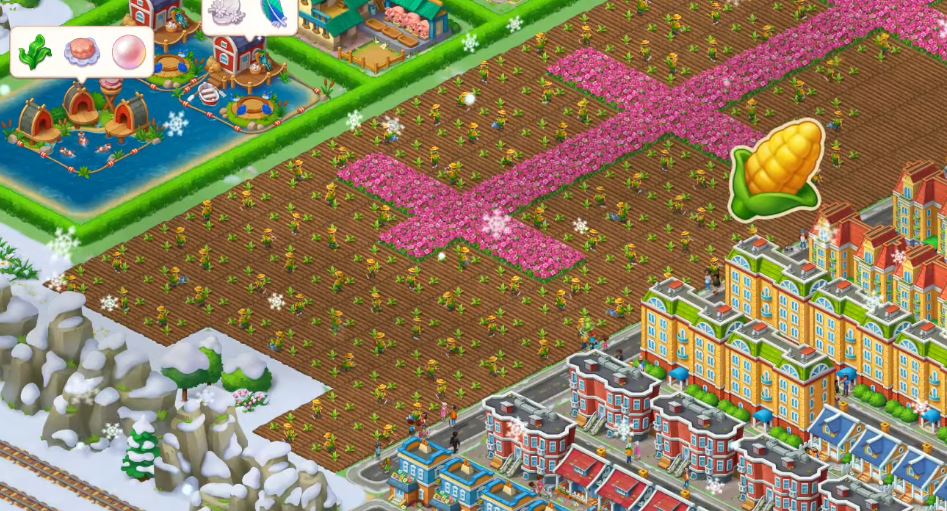

A familiar sound emanates from a smartphone somewhere in the middle of a peaceful evening. The gentle chime of a reward alert. Another turn on a vibrant wheel. Millions of players have made this moment a part of the odd ritual surrounding a new in-game feature called Frozen Fortune in the farming simulation game Township.
The event appears straightforward at first glance. Gather tokens, turn a wheel, and navigate an icy virtual ship. However, after observing players’ interactions with the event for some time, it becomes evident that beneath the happy visuals, a little more complex activity is taking place.
Frozen Fortune is a time-limited cooperative game that emphasizes chance and teamwork. Each player shares a ship track with a maximum of three partners. Earning tokens—typically by finishing match-3 puzzle levels—and using them to spin a wheel that moves the ship closer to the finish line are the keys to progress.
| Category | Details |
|---|---|
| Event Name | Frozen Fortune |
| Game | Township |
| Developer | Playrix |
| Event Type | Limited-time cooperative in-game event |
| Gameplay Style | Match-3 progression with partner collaboration |
| Key Mechanic | Earn tokens and spin a reward wheel to move ships |
| Main Goal | Complete three ship tracks and unlock the grand prize |
| Rewards | T-Cash, boosters, items, and profile frames |
| Availability | Appears after reaching level 75 |
| Reference Website | https://township.fandom.com |
It seems simple enough. However, a recurring theme when perusing online forums is perplexity.
Many players acknowledge that when the event first started, they didn’t fully comprehend its mechanics. Suddenly, invitations appear. Partners need to be selected fast. Then, in a flurry of vibrant animations, the wheel starts to spin, revealing points and rewards.
It’s difficult to ignore how much contemporary mobile games depend on curiosity combined with a healthy dose of uncertainty as you watch this play out.
Tokens are at the heart of the mechanics themselves. While more difficult puzzle levels can yield three or even five tokens, simpler puzzle levels may only yield one. During the event, those tokens turn into money, enabling players to spin the Frozen Fortune wheel.
A ship advances by a set number of points with each spin, sometimes five, sometimes thirty, and sometimes a hundred. Even free spins or unique “super moves” that significantly accelerate progress are triggered by rare bonus segments.
One can understand why developers find the design appealing. This kind of system promotes constant play. Tokens are sought after by players. Spins result from tokens. Rewards come from spins. The cycle continues, subtly increasing the amount of time spent in the game.
However, a cooperative layer is also introduced by the event, which modifies the emotional dynamics. In Frozen Fortune, each of the three ships has a partner. Both players must contribute points for progress to be made. The ship stalls if one player quits playing. Reactions to that detail have been conflicting.
Some players take pleasure in the cooperative element, viewing it as a small-scale adventure with friends. However, some people are concerned about being matched with partners who are not active. It’s still unclear if more control over partner replacement or selection will be available in future updates.
An additional layer of motivation is added by the rewards themselves.
Milestone prizes, such as boosters, in-game money, and unique items utilized in Township’s puzzle mechanics, are included in every ship track. After completing all three ships, the Grand Prize chest opens up, frequently holding rare boosters and T-Cash, among other valuable resources.
That last reward can feel important to seasoned players. Township has always struck a balance between puzzle challenges and farming simulation, and games like Frozen Fortune combine the two in ever-more complex ways.
Additionally, the wheel itself has a subtle psychological design.
Before spinning, players can select multipliers of 1x, 5x, 10x, or even 50x. Greater multipliers promise greater progress but use more tokens. According to the calculation, the average value per token stays relatively constant regardless of the multiplier. However, it feels like a completely different experience.
Progress is steady but slow with smaller spins. The wheel becomes volatile as the multipliers increase. Sometimes there are huge wins, but there are also disappointing spins that quickly deplete tokens. It’s the age-old conflict between risk and patience.
An intriguing aspect of human behavior can be discovered by observing how players respond to these options. As they watch the ships slither forward, many begin cautiously with little spins. The temptation to wager on bigger multipliers increases later when there is less time.
And maybe that’s why the Township community has been talking about Frozen Fortune so much. Cooperation, chance, strategy, and a little bit of uncertainty are all combined into one small system during the event.
Some gamers adore it. Others find it overwhelming to have another feature added to a game interface that is already packed. Some even question if the main purpose of the event is to promote spending on tokens or additional moves.
Today’s mobile games must strike a careful balance between revenue and entertainment. Systems that maintain player engagement are necessary for developers. New reasons to come back every day, spin the wheel again, and try for another prize are provided by events like Frozen Fortune.
One gets the impression that the event encapsulates something of contemporary gaming culture as you watch the ships slowly move across the icy progress bar. Progress happens little by little. Incentives come and go. Nearly as important as the destination is the journey.
And occasionally, the silent chance that the next spin will yield the largest prize is all that is needed to keep players interested.
