
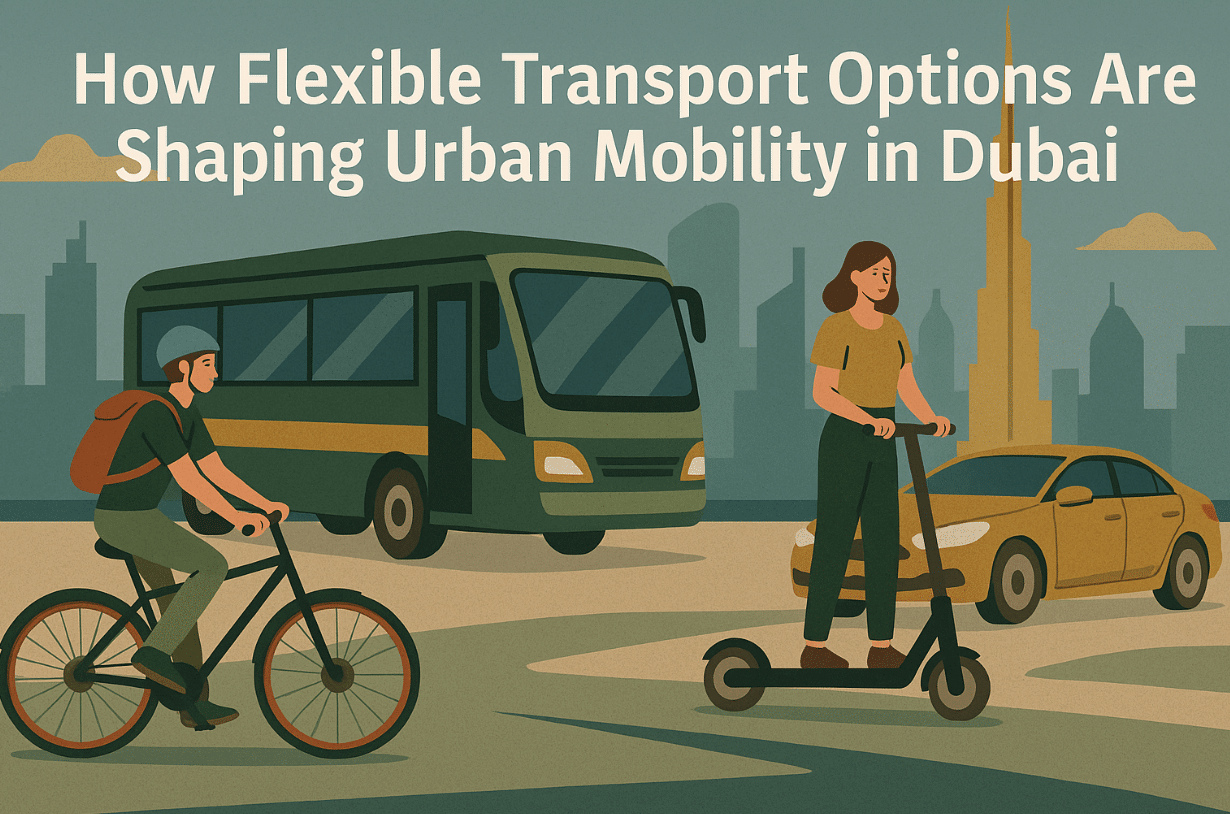

Dubai’s rapid growth and futuristic ambitions have made it a living laboratory for innovative transport solutions. Traditionally a car-centric city, Dubai has been diversifying its mobility ecosystem with flexible transport options – from app-based ride services and micro-mobility to novel car rental schemes. These options offer residents and tourists more convenient, on-demand ways to get around without relying solely on privately owned cars. The shift is driven by both private-sector innovation and public initiatives, aiming to ease congestion and improve sustainability. This article examines how these flexible transport modes – including convertible car rental, car-sharing, ride-hailing, and micro-mobility – are reshaping urban mobility in Dubai’s ever-evolving landscape.
Flexible Car Rentals and Car-Sharing
One of the most notable shifts in Dubai’s mobility landscape is the rise of flexible car rental and sharing services. Residents and tourists alike are taking advantage of short-term rentals and car-sharing platforms as an alternative to owning a vehicle. With a fully digital experience and no human interaction needed, these services offer ultimate convenience – users can pick up a car, drive to their destination, and drop it off, paying only for the time used. This on-demand access to cars eliminates the hassles of ownership like maintenance, fuel, and insurance, since those costs are included in the service.
According to Octane Rent (https://octane.rent/convertible-car-rental-dubai/), a leading car rental platform in the UAE, nearly 30% of their clients opt for convertible rentals during Dubai’s cooler months to enjoy the iconic skyline and winter sunshine without the commitment of ownership. Visitors can easily rent a convertible – or any vehicle from an economy runabout to a luxury sports car – for a day or a week to enjoy Dubai’s skyline and winter sunshine, all without the commitment of ownership. Residents, too, leverage these rentals for special occasions or weekend trips, showing how services adapt to personal and seasonal needs. Car subscription services take flexibility further by enabling monthly vehicle swaps; for example, one can use an SUV for a family trip then switch to a convertible in cooler months, all under one plan. Such choice is reshaping expectations around car ownership – why buy a costly vehicle for infrequent use when you can rent or subscribe on demand?
Equally transformative is the rise of car-sharing services that provide on-demand, short-term car access. Platforms like Udrive and Ekar, launched with RTA’s support, let users locate and unlock vehicles via a mobile app and pay by the minute or hour. Introduced as a last-mile solution, these services bridge gaps in the public transit network by providing “independent and flexible options at a reasonable rate” for short trips. A commuter might pick up a car at a metro station, drive to their final stop, and leave it in an approved parking spot – all without the paperwork of a traditional rental. At roughly AED 0.50 per minute (including fuel and parking), these app-based rentals can be cheaper than a taxi while offering greater autonomy. The RTA’s endorsement of these programs underscores their strategic role: positioned as an extension of public transit, car-sharing encourages people to rely less on private cars. In practice, these options give individuals the freedom of a personal car only when needed, without the costs and hassles of full-time ownership.

Ride-Hailing and Integrated Transit Solutions
Dubai’s embrace of ride-hailing has been swift and significant. Services like Uber and the home-grown Careem have become ubiquitous, offering on-demand rides at the tap of a button. The RTA’s partnership with Careem to launch Hala, the official taxi e-hailing service, has digitized the emirate’s taxi fleet. By 2022, about 30% of all taxi trips in the city were booked through e-hailing apps, and the RTA aims to boost that to 80% in the near future. This shift is not just about convenience; it’s part of a strategy to make urban transport smarter and more efficient. Expanding e-hail services aligns with Dubai’s goal of becoming a leading smart city and with global trends of reducing private car dependence. In practice, e-hailing has improved taxi efficiency by dynamically matching supply with demand, cutting wait times and wasted mileage.
Dubai is also integrating ride-hailing into a unified transit ecosystem. The public transport network is increasingly connected with private mobility services via technology. The RTA’s S’hail mobile app, for instance, serves as a one-stop platform where users can plan a journey across multiple modes and even book ride-hailing cars, taxis, or “smart rental” vehicles in the same interface. Such integration makes it easy to combine modes in one trip. For example, one might ride the Metro, then use S’hail to book a taxi for the last leg of the journey. By improving these first- and last-mile connections, ride-hailing becomes a complement to mass transit rather than a competitor. The model appears to be working: usage of public and shared transport in Dubai has been rising (up about 6% in early 2024 compared to 2023), and the government has set a target for 25% of all trips to be via public or shared transport by 2030.
Micro-Mobility and Last-Mile Options
The rise of micro-mobility solutions is the latest trend enhancing urban mobility in Dubai. In partnership with the RTA, Careem operates a bike-sharing network that has seen impressive uptake. Since its launch in 2020, the Careem Bike service has recorded over 7.3 million trips in Dubai. Notably, roughly 70% of these rides are for daily commutes rather than just leisure outings. With docking stations spread across Dubai, the bike-share system gives residents and visitors an active, convenient option for short distances, often linking directly with Metro and bus stations.
The city is also witnessing a boom in electric scooters (e-scooters) for last-mile travel. The RTA has authorized multiple e-scooter rental operators (such as Tier, Lime, and others) and expanded dedicated cycling/scooter lanes to more than 20 districts. Users can unlock an e-scooter via a phone app and ride through growing networks of safe lanes that connect neighborhoods to transit stops – explicitly to “encourage residents to leave cars at home”.
To support this trend, Dubai is investing in first- and last-mile infrastructure like bike lanes, crossings, and parking facilities that make micro-mobility safer and more practical. These efforts signal a clear strategy: if people have a pleasant and safe way to cover the short distance from a transit station to their final destination, they are more likely to opt for public transport for the longer portion of the journey. In this way, micro-mobility options act as the connective tissue of Dubai’s transport network, extending the reach of buses and trains right to the doorstep of commuters.
