
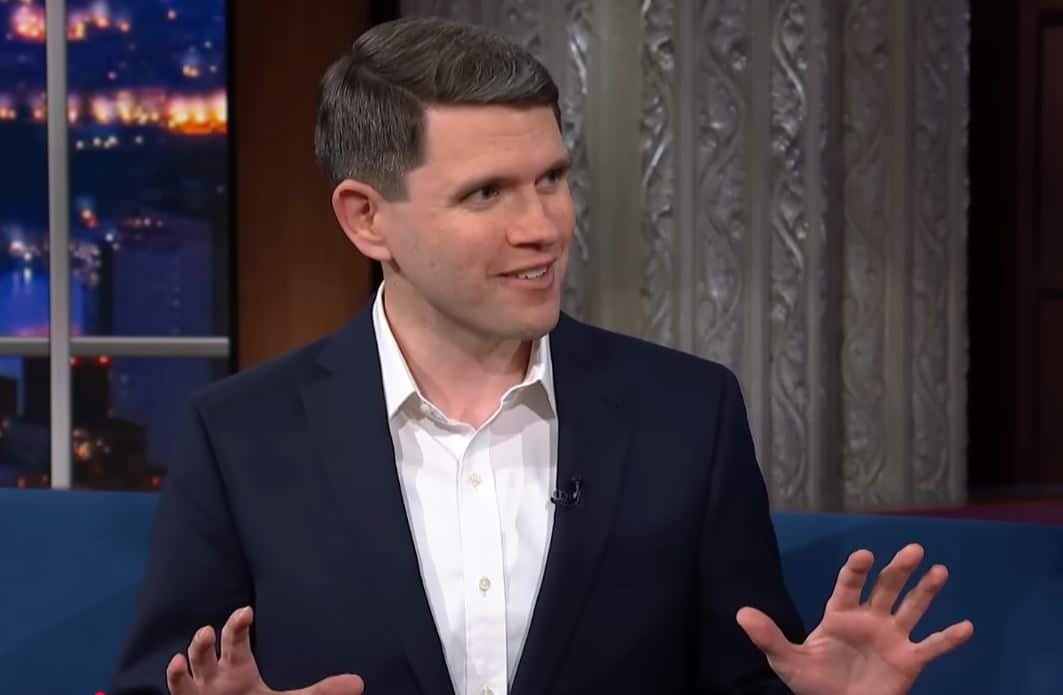

It appeared that the people in the Ed Sullivan Theater that evening were unaware that they were witnessing something that would never be shown on television.
As Texas state representative James Talarico discussed faith, politics, and power with unusual composure, Stephen Colbert sat behind his desk and leaned forward a little. Warm amber was the usual glow of the set lights. A stage assistant held cue cards in neat order. Everything appeared to be typical. Nevertheless, the conversation felt different in some way—less formal, more open.
| Category | Details |
|---|---|
| Full Name | Stephen Colbert |
| Guest Involved | James Talarico |
| Show | The Late Show with Stephen Colbert |
| Network | CBS |
| Interview Year | 2026 |
| Controversy | CBS declined to air interview on broadcast television |
| Online Impact | Millions of views on YouTube |
| Political Context | Texas Senate race |
| Location | Ed Sullivan Theater, New York |
| Reference | https://www.cbs.com |
In a matter of hours, CBS would remove the interview from its broadcast schedule.
Colbert subsequently clarified, with apparent annoyance, that network attorneys were concerned about breaking federal “equal time” regulations, which may mandate that broadcasters provide rival political candidates with comparable airtime. The decision might have been made out of pure legal caution. However, there’s a feeling that something else was going on as well, something more difficult to measure that involved timing, risk, and corporate nerves.
The interview went online instead of disappearing.
That choice, which may have been made to draw less attention, had the opposite outcome. The video quickly went viral, receiving millions of views. Observing it online, one gets the impression that the internet has evolved into a parallel television system, where choices intended to restrict exposure frequently increase it instead.
Outside of Texas politics, Talarico was largely unknown, but all of a sudden, he rose to national prominence.
His cool, collected voice stood in stark contrast to the frenzied fervor typically connected to viral political moments. Without raising his voice, he discussed nationalism, Christianity, and moral responsibility. It’s still unclear if the controversy surrounding its suppression or his message drew in more viewers. Colbert, on the other hand, appeared to be torn between roles.
He has been carefully and precisely balancing comedy and political commentary for years. However, it felt less staged this time. Using language more akin to that of a journalist than a comedian, he publicly criticized the network’s choice.
It’s difficult to ignore how out of the ordinary that was.
Late-night television has always occupied a peculiar space that is simultaneously a cultural mirror and an entertainment medium. Johnny Carson steered clear of direct political confrontation. Leaning into it was Jon Stewart. Colbert has attempted to do both in his own unique way. This dispute implied that the boundaries are still up for debate.
The tension was probably more complex behind the scenes.
Most viewers are unaware of the regulatory frameworks that govern how networks operate. Attorneys consider the risks. Executives expect to receive complaints. Silently, decisions are made. Observing this in public gives the impression that the workings of television were momentarily revealed.
The timing couldn’t have been more crucial for Talarico.
After the interview was made public, fundraising reportedly skyrocketed. He was mentioned in headlines that might have otherwise completely disregarded his campaign. He may have benefited from the controversy by getting attention, which is something that campaigns seldom do on their own.
However, attention is erratic. The episode was perceived as censorship by some viewers. For others, it was just standard compliance. Others appeared to be more interested in what it revealed about television in general than in the politics. Algorithms and social media feeds now play the same role as the medium that once dominated public discourse.
None of that could be seen inside the theater. Only the desk, the stage, and two men conversing were present.
Colbert listened, smiling and nodding now and then, but he mostly let the conversation flow. Now that I’ve seen those moments and know what transpired later, I get the impression that the interview’s true significance wasn’t political.
It demonstrated the vulnerability of the conventional television model. There was no CBS broadcast of the interview. Millions of people nevertheless watched it.
