
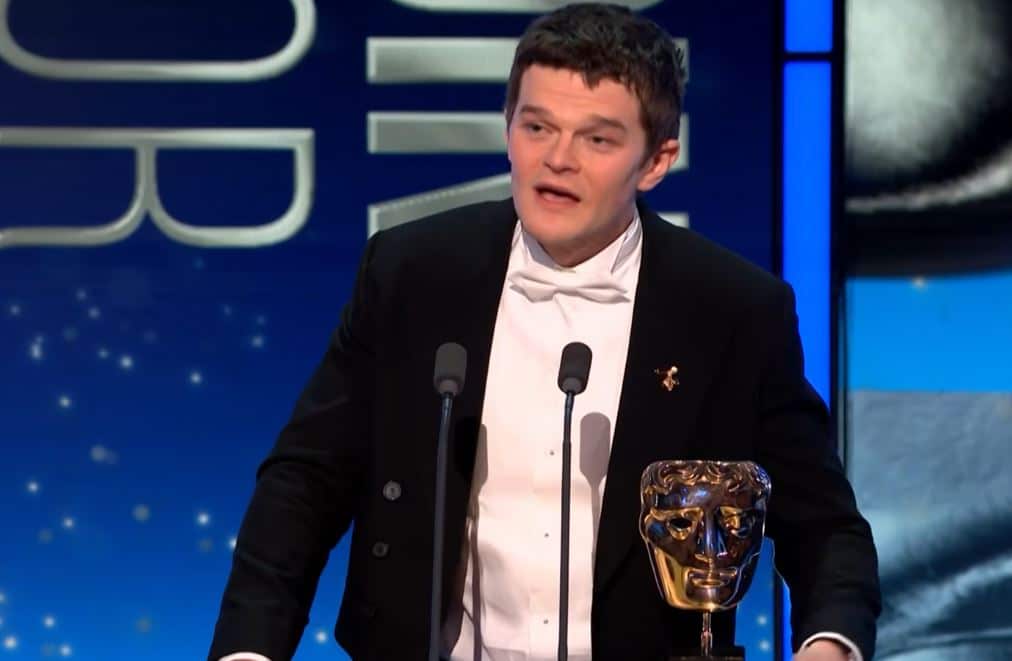

It didn’t seem like a practiced moment. Robert Aramayo stood on stage at the Royal Festival Hall in London, his hands shaking a little as he gazed out at a room full of people he had grown up seeing on screen. There was Leonardo DiCaprio. Chalamet, Timothée. Even Aramayo might not have been entirely convinced that his name had just been revealed.
His words, “I honestly cannot believe I have won this award,” didn’t sound like a courteous exaggeration for once.
When something unexpected occurs during award ceremonies, a certain kind of silence descends. Not uncomfortable, but thoughtful. It seemed as though the industry was realigning itself as it watched Aramayo accept the BAFTA for Best Actor for I Swear, changing its presumptions about who should be at the forefront of Hollywood’s focus.
| Category | Details |
|---|---|
| Full Name | Robert Aramayo |
| Born | November 7, 1992, Hull, England |
| Age | 33 (as of 2026) |
| Profession | Actor |
| Breakthrough Role | Young Ned Stark in Game of Thrones |
| Major Film | I Swear (2025) |
| Major Award | BAFTA Best Actor (2026) |
| Notable TV Role | Elrond in The Lord of the Rings: The Rings of Power |
| Oscar Status | Not nominated in 2026; widely discussed for future Oscar contention |
| Reference | https://www.bafta.org |
The movie isn’t your average awards juggernaut. I Swear, which is filmed with an almost invasive intimacy, chronicles a man with Tourette syndrome as his everyday activities take place in small spaces and public areas where strangers gaze for extended periods of time. Aramayo doesn’t give a spectacular performance. It’s restrained and occasionally nearly uncomfortable to watch. Voters might have reacted favorably to that restraint.
Understatement has a way of sticking around longer. Aramayo played a supporting role in popular franchises for many years. In Game of Thrones, he made a fleeting but memorable appearance as the youthful Ned Stark, with a seriousness in his face that belied his age. Later, he played Elrond in The Rings of Power, which was shot on huge sets with green screens spanning entire soundstages. He was a part of Amazon’s enormous fantasy machine.
He didn’t feel like a conventional leading man, though, even at that point.
He frequently appeared more like a theater actor waiting for his cue than someone attempting to take over a room when he walked through press conferences in those years with his shoulders slightly hunched. It seems as though he never really accepted the apparatus of celebrity that surrounded him. It’s still unclear if that’s deliberate or just his personality.
Overnight, the BAFTA victory altered the mood.
For a long time, studio executives, agents, and producers have viewed awards as indicators of who could produce the next wave of movies. Conversations that previously did not mention Aramayo’s name are now doing so. Oscar talk has already started, but with an odd disclaimer.
That detail is more important than you might think. Aramayo’s performance is in a sort of suspended state because I Swear was not eligible for the current Oscars because of when it was released. Although it has been acknowledged, praised, and talked about, it has not yet been put to the test in Hollywood’s most prominent setting. Perhaps the delay will be to his advantage.
In the culture of awards, momentum is erratic. It fades sometimes. It can occasionally accumulate weight subtly over time. Aramayo’s victory seems to have sowed a seed rather than brought a story to a close.
There has been a discernible change in how audiences respond to him now. Once-routine interviews now evoke curiosity. Longer questions remain. It appears that people are attempting to ascertain his true identity.
Actors who feel a little out of place in Hollywood have always been attracted to it. That was Daniel Day-Lewis’s trait. Joaquin Phoenix did the same. At first, they weren’t immediately apparent stars. By refusing to act like them, they rose to fame.
Aramayo may be on a similar course.
He is seen holding the mask-shaped trophy tightly, almost protectively, in backstage pictures from the BAFTAs. He doesn’t look victorious. It’s considerate. Perhaps even overpowered.
It’s difficult to ignore the speed at which stories are created around such events.
One prize turns into a pivotal moment. A single performance serves as the benchmark for all subsequent performances. Expectations increase. Opportunities shift. Naturally, pressure is the danger.
Actors who come on the scene out of the blue frequently encounter a business that wants to define them before they have had a chance to do so. Whether Aramayo will gravitate toward bigger, more commercial roles or turn to smaller, more intimate endeavors is still up in the air.
There are risks associated with both routes. He stays in between for the time being. Not quite a contender for an Oscar. No longer quite an outsider, either.
Just an actor who subtly changed the course of his career while standing on a London stage and appearing truly surprised to be there.
