

Financial services firms reported strong returns on artificial intelligence investments in 2025, yet 62% of their AI initiatives remain trapped in pilot or development stages, unable to scale beyond proof-of-concept.
The implementation gap reveals a sector caught between ambition and execution. While 89% of organisations confirmed that ROI from AIOps investments met or exceeded expectations, just 12% achieved full enterprise-wide deployment of AI projects, according to research released by Riverbed on February 4th.
That’s a remarkable disconnect.
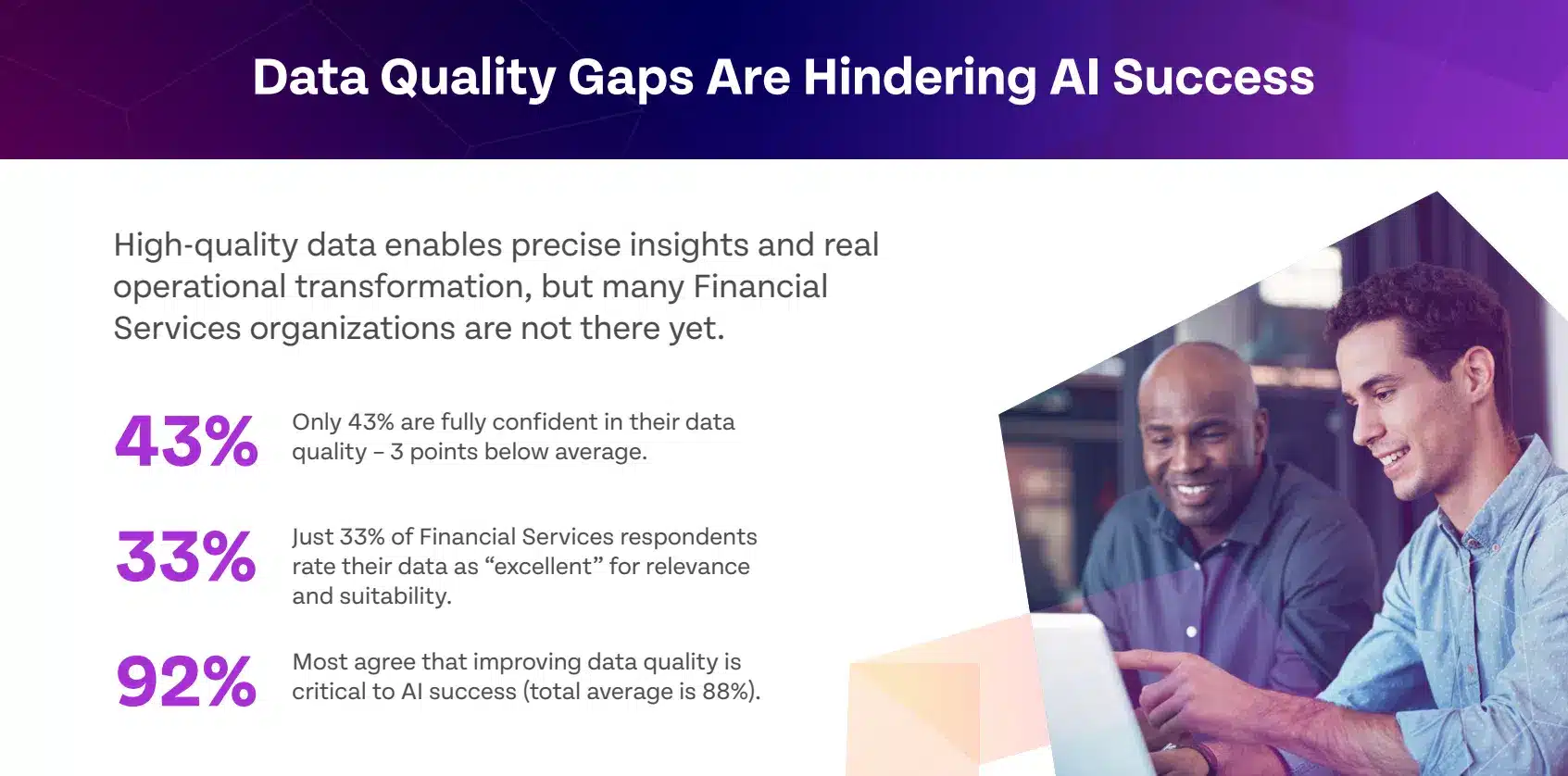
The culprit? Data quality. A sweeping 92% of decision-makers in the industry agreed that improving data quality is critical to AI success—the highest proportion across all sectors surveyed. Yet only 43% expressed full confidence in the accuracy and completeness of their organisation’s data, marking the lowest confidence level among industries examined in the global study.
“Financial Services organizations are among the most sophisticated and disciplined adopters of AI, and our research shows they’re already seeing strong returns,” said Jim Gargan, Chief Marketing Officer at Riverbed. “However, the sector operates under unique pressures, including rigorous regulatory scrutiny, zero tolerance for downtime and a critical need for data accuracy. What’s clear is that success now depends on simplifying IT, consolidating observability tools and vendors, improving data quality, embracing open standards like OpenTelemetry, and ensuring network and application performance can support AI at scale. At Riverbed, we are actively supporting some of the world’s largest Financial Services organizations as they bridge this gap and turn AI ambition into operational reality.”
The survey, conducted by Coleman Parkes Research in July 2025, polled 1,200 business decision-makers, IT leaders and technical specialists across seven countries.
Complexity compounds the challenge. IT teams at financial services organisations currently juggle an average of 13 observability tools from nine different vendors, creating fragmented visibility across applications, networks and user experience. The sprawl slows decision-making and obscures performance issues across increasingly distributed environments.
In response, 96% of organisations have begun consolidating tools and vendors across IT operations. Nearly all—95%—agreed that a unified observability platform would simplify identifying and resolving operational issues. Tellingly, 95% are considering new vendors as part of this consolidation, the highest rate among all industries surveyed. That willingness to rethink long-standing technology relationships signals mounting frustration with existing approaches.
Meanwhile, employees spend 41% of their working week using unified communications tools such as video calls, messaging platforms and collaborative workspaces. Two-thirds described these tools as essential to operating effectively. Performance, however, tells a different story.
Only 47% of financial services organisations reported high satisfaction with UC performance, whilst 44% acknowledged regular issues. Those problems generate real operational drag: UC-related issues account for 16% of all IT tickets, requiring an average of 41 minutes to resolve. Nearly one in five tickets demand more than an hour. In a sector where responsiveness directly affects customer trust, inconsistent communications tools create persistent friction.
The path forward increasingly runs through open standards. Financial services organisations lead all sectors in OpenTelemetry adoption, with 92% already leveraging the framework to enable consistent data collection and correlation across applications, infrastructure and user experience. Nearly all respondents—96%—identified cross-domain correlation as critical to their observability strategy, whilst 99% agreed that OpenTelemetry reduces vendor lock-in and increases flexibility.
Crucially, 97% view the standard as a foundation for future AI-driven automation.
As AI initiatives mature beyond experimental phases, attention has shifted from models to the movement of data that fuels them. Financial services organisations attach greater importance to AI data movement than any other sector, with 94% viewing it as important to overall AI strategy and 37% describing it as critical and foundational to how they design and execute artificial intelligence.
Network performance and security emerge as decisive factors. A commanding 81% of respondents cited them as essential to AI success—the highest proportion across industries surveyed. With AI data increasingly distributed across public cloud, edge and co-location environments, governed and high-performance architectures have become non-negotiable.
Looking ahead, 76% of financial services organisations plan to establish an AI data repository strategy by 2028, underscoring the urgency of building infrastructure that balances innovation with compliance and control.
Yet for now, just 40% feel fully prepared to operationalise their AI strategy today. The gap between aspiration and readiness persists, even as returns demonstrate the value waiting on the other side. What separates the 12% who deployed enterprise-wide from the 62% still in development comes down to fundamentals: trusted data, simplified tooling, open standards and networks capable of supporting AI at scale.
The sector understands what’s required. Implementation remains the harder part.
