
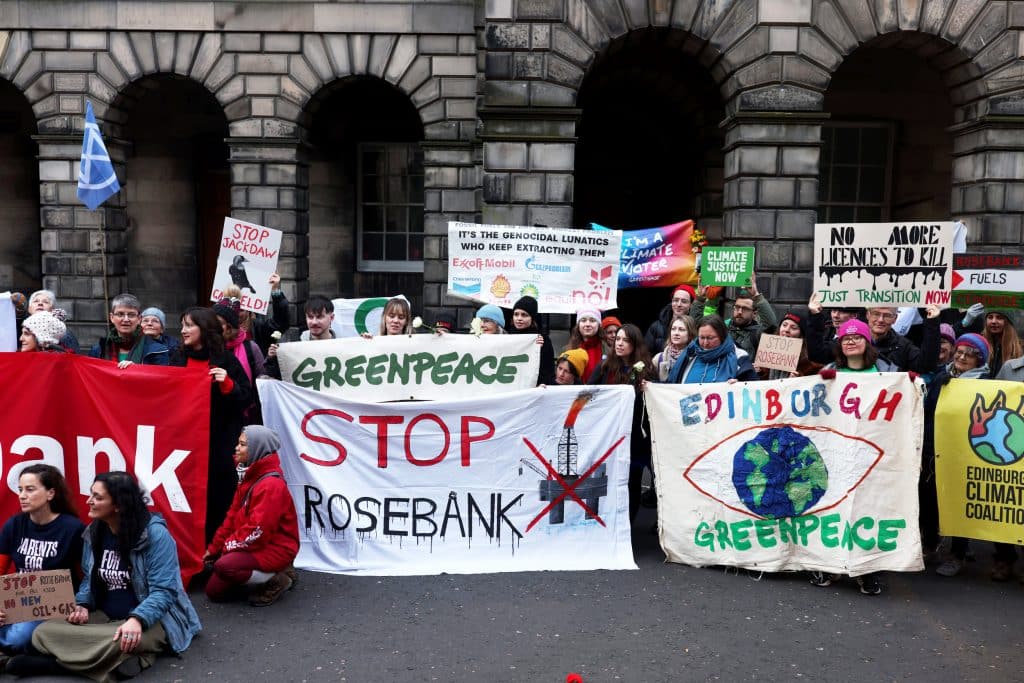

A crucial judicial review has commenced in Edinburgh challenging the consents granted to Shell and Equinor’s North Sea oil and gas projects.
- Greenpeace and Uplift argue these consents unlawfully ignored emissions from burning the extracted fossil fuels.
- The Supreme Court’s Finch ruling now demands that total carbon impacts, including consumer use, be considered.
- Shell and Equinor might admit to the unlawfulness but stress the need for these projects for UK energy security.
- The UK government has chosen not to defend these consents, suggesting a silent acceptance of their illegality.
In a pivotal legal turn, a judicial review has begun today in the Scottish Court of Session. This review focuses on the legality of development consents given to Shell and Equinor for their oil and gas fields in the North Sea. Initially contested by Greenpeace and Uplift, the review gains ground due to a recent Supreme Court ruling known as the Finch ruling. This ruling enforces the consideration of total carbon emissions, which includes those emissions produced by customers burning the extracted oil and gas.
Greenpeace argues that the permissions for the Jackdaw and Rosebank projects overlooked emissions from the burning of fossil fuels, a critical oversight termed as Scope 3 emissions. These emissions profoundly contribute to global environmental challenges, igniting events such as floods and wildfires across different continents. Thus, Greenpeace has taken legal action against Shell, Equinor, and Ithaca to prevent further development of these sites.
While Shell and Equinor are expected to acknowledge the legal misstep in granting these consents, they maintain a stance on the projects’ pivotal role in ensuring UK energy security. They argue that halting these projects would necessitate increased imports with potentially higher carbon footprints. Shell has already progressed significantly with Jackdaw, involving considerable infrastructure and operational commitments.
The UK government’s decision not to defend these consents bolsters Greenpeace’s claims, described by them as a ‘tacit acceptance’ of the permits’ unlawful nature. Despite this, private companies involved are resisting this legal challenge, contending that the projects are essential amidst declining production from existing gas fields.
Environmental activists and experts, including Lord Debden, highlight the inconsistency of approving new fossil fuel projects with the UK’s broader climate goals. They emphasise that continuing with Jackdaw and Rosebank undermines efforts to transition to renewable energy sources and exacerbate climate crises rather than mitigate them.
The judicial review stands as a significant test of the UK’s commitment to environmental accountability and energy policy adaptation.
