
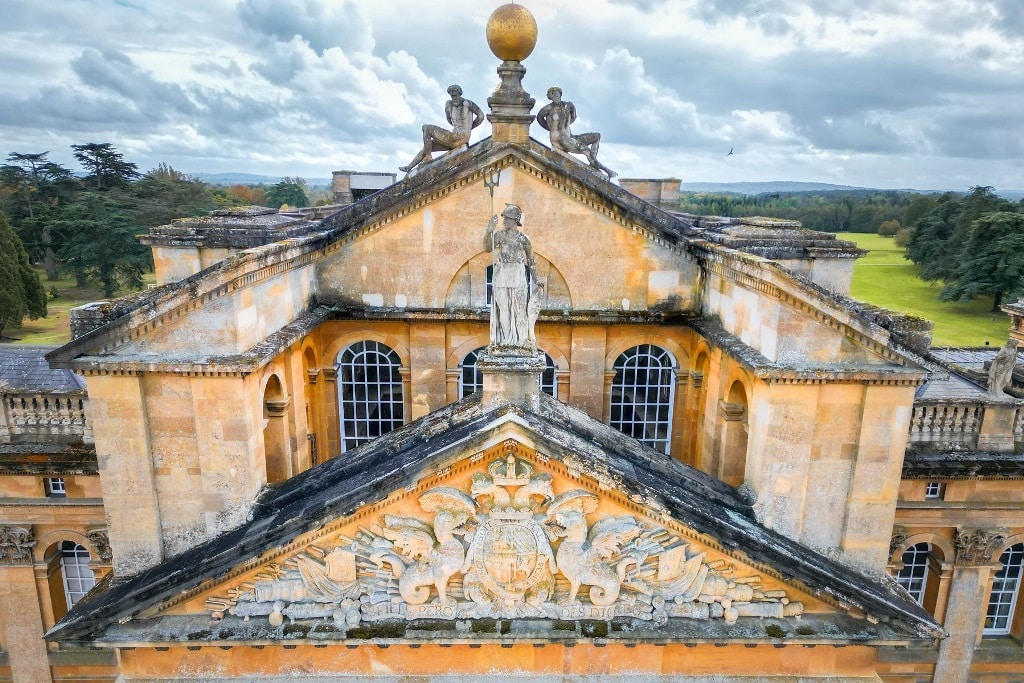

An urgent restoration project begins at Blenheim Palace to address critical roof issues.
- The palace, a UNESCO World Heritage Site, faces significant roof damage due to age and poor drainage.
- DBR Ltd spearheads a £10.4m restoration to protect the palace’s historical features.
- Water damage endangers celebrated artworks by Sir James Thornhill and paintings of historical significance.
- Enhancements will include improved drainage, environmental stability, and safety measures.
Work is set to begin on an extensive £10.4 million restoration project at Blenheim Palace, located in Woodstock, to address significant structural concerns. The building, known for its historic and architectural importance, is undergoing this project after more than three centuries of exposure to rain and inadequate drainage systems, which have compromised the roof’s integrity.
Blenheim Palace, a UNESCO World Heritage Site and the domicile of the Duke of Marlborough, requires substantial repairs to its roof, attic timbers, and ceilings. DBR Ltd, experts in conserving historic buildings, have been enlisted to execute the restorative work necessary to safeguard this architectural marvel.
Commencing in January, the focus will be on a complete restoration of a major portion of the palace’s roof. This aims to enhance the building’s resilience against the elements, ensuring its preservation for future generations. Presently, leakage is evident in areas such as the Great Hall, the Heights—once the servants’ quarters—and the Saloon, where water ingress has damaged the illustrious ceiling fresco by Sir James Thornhill.
The fresco portrays the Duke of Marlborough presenting a battle plan to Britannia. This historical artwork, along with other significant paintings, has suffered from water damage, smoke damage, dirt, mould, and decay. Such conditions have caused the ceiling to collapse and led to a loss of historical fabric, necessitating urgent conservation measures.
Externally, the roof displays severe stone delamination and rusting iron components, which have expanded dramatically, breaking away stonework and posing safety risks. With the roof covering nearly an acre and being served by just six downpipes—300% below required capacity—enhancements to drainage are a critical part of the plans.
The project’s objectives include restoring the roof to a watertight state, stabilising the environment around the nationally significant paintings, reducing safety hazards, and extending the stonework’s life by curbing its decay. Moreover, the restoration aims to complete fire compartmentation work, boost gutter capacity, and improve energy efficiency where feasible.
Kelly Whitton, head of built heritage at Blenheim Palace, described the endeavour as one of the most ambitious in the palace’s history. She highlights the complexity of the £10.4 million restoration, which will blend traditional craftsmanship with modern building techniques to ensure the structural integrity of the site.
The restoration of Blenheim Palace’s roof is a vital undertaking aimed at preserving its historical integrity.
