
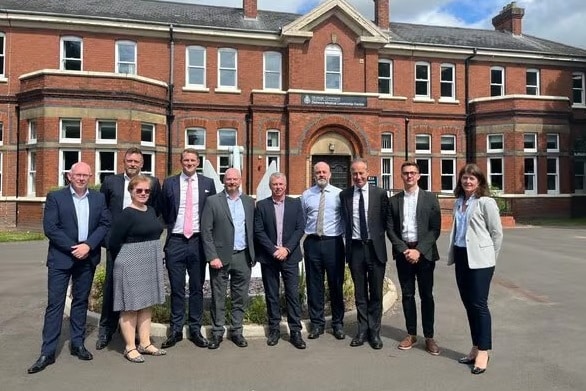

The Defence Infrastructure Organisation has partnered with six firms to enhance living conditions for the armed forces.
- Six construction companies have been selected to provide single living accommodation through a strategic alliance.
- This initiative is a six-year plan, part of a larger project to improve 40,000 bedspaces over a decade.
- The program aims for efficiency with a library of adaptable designs for various military settings.
- A new collaborative approach, focusing on off-site construction, is set to enhance value and consistency.
The Defence Infrastructure Organisation (DIO), in its ongoing endeavour to improve living standards for military personnel, has enlisted the services of six construction companies. These firms, including Bowmer & Kirkland, ExtraSpace Solutions, Kier McAvoy, Kier Metek, Laing O’Rourke, and Reds10, have been tasked with the development of single living accommodation for the armed forces. This development forms part of a broader Ministry of Defence objective to build or upgrade 40,000 bedspaces within a ten-year timeframe, signifying a significant commitment to enhancing the living conditions of military personnel.
The selected companies will operate under an existing framework facilitated by Crown Commercial Services. Over the next six years, this partnership aims to deliver 16,000 new bedspaces. Emphasising the importance of innovation and collaborative effort, the companies have been encouraged to leverage insights from past projects to refine future deliveries. Such a strategy enables continuous improvement and is expected to yield substantial advancements in the quality and delivery speed of military accommodation.
In pursuit of operational efficiency, the project incorporates a library of single living accommodation (SLA) designs. These designs offer a common base with adaptable features tailored to the specific requirements of each site, such as varying room numbers, and accommodate both temporary and permanent occupancy. This flexibility is critical for meeting diverse needs ranging from recruits in initial training to long-term military personnel residents.
The approach to construction prioritises off-site building methods, which allow for prefabrication and modular construction, leading to faster and more consistent results. From 2026, all projects will adopt this innovative method, ensuring uniformity and high standards across all new builds. Charlie Hoskins, director of major programmes at the DIO, underscored the alliance’s significance, noting that it aims to improve living conditions efficiently and consistently, guaranteeing value for money.
With this ambitious initiative underway, the DIO and its partners are steadfast in their mission to revolutionise living standards for the armed forces, fostering an environment of continuous improvement and operational excellence.
This strategic alliance marks a pivotal step in enhancing military living conditions through innovative and efficient construction methods.
