
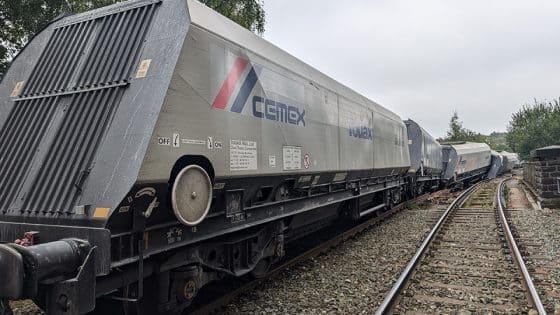

A recent freight train derailment in Manchester has prompted crucial safety advisories from the Rail Accident Investigation Branch (RAIB).
- The incident involved a shift from ballasted to longitudinal timber tracks, highlighting potential infrastructure vulnerabilities.
- Key issues identified include gauge spread and fatigue failure in crucial track components such as chair screws.
- Investigations reveal that non-high-tensile strength materials may have contributed to the failure of track components.
- Network Rail has acknowledged the findings and plans to implement comprehensive measures to enhance track safety.
In the wake of a significant freight train derailment in Manchester, the Rail Accident Investigation Branch (RAIB) has issued urgent safety guidance directed towards Network Rail and other entities involved in rail infrastructure maintenance. The incident, which occurred on 6 September 2024, involved a freight train travelling from Peak Forest to Salford. As the train traversed a bridge at Audenshaw, Manchester, nine of its 24 aggregate-laden wagons derailed, causing substantial damage to the railway infrastructure.
Investigations by the RAIB determined that the derailment was precipitated by gauge spread in the initial section of the bridge. This section marked the transition from ballasted track to a longitudinal timber system, a change that proved critical under the train’s weight. The bridge’s curvature and the specific design of the track, supported on PAN M6 baseplates using only two LSA chair screws, played a role in this failure. Inspectors recovered 13 failed chair screws, none marked with ‘HT’, suggesting they were not made from high-tensile material, a factor potentially leading to their fatigue failure.
Metallurgical examinations of the failed screws indicated signs of both low-cycle and high-cycle fatigue failures. The plane of failure typically occurred just beneath the upper level of the timber, a mode of failure that is challenging to detect through visual inspection. In its advisory, the RAIB underscored the need to consider specific risk factors, including the use of hardwood timbers in longitudinal systems and the presence of non-HT screws, which heighten the risk of lateral support loss and gauge spread under dynamic loads.
John Edgely, Network Rail’s Chief Track, Switches, and Crossings Engineer, acknowledged the value of RAIB’s comprehensive and forensic approach to rail safety investigations. Network Rail has committed to utilizing the insights from this urgent safety advice to develop detailed new guidelines for its engineering teams, thereby prioritizing enhanced track safety measures.
The recent findings highlight critical infrastructure weaknesses, necessitating swift action to ensure railway safety.

