
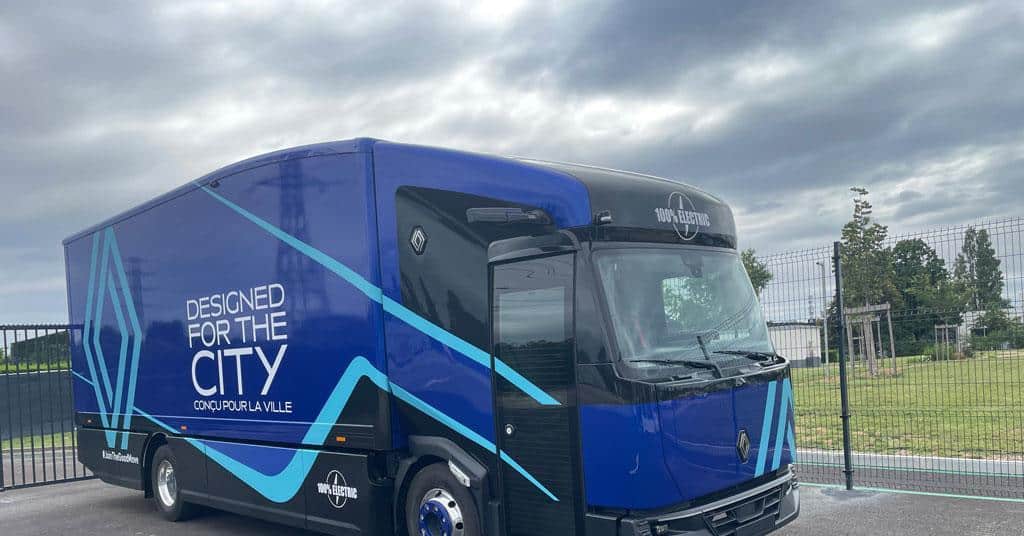

Renault Trucks illustrates the viability of electric trucks, demonstrating only a modest 5% additional cost compared to traditional diesel vehicles.
- The company has been advancing its battery electric vehicle initiatives and recently hosted open days to showcase progress.
- Production capability has scaled with current outputs at 2-3 trucks daily, with potential to increase as demand grows.
- Renault Trucks continues to refine diesel engines but sees electric vehicles as the primary future solution.
- Challenges like charging infrastructure remain, however collaborations are underway to navigate these obstacles.
Renault Trucks has progressively advanced in its battery electric vehicle (BEV) journey over four years, marked by hosting open days at its demo centre in Saint-Priest. This centre, based at its axle plant near Lyon, provides a first-hand look at their achievements and ambitions.
Production at the Bourg-en-Bresse plant currently includes the manufacture of two to three BEV Range T and C trucks daily, all custom ordered, with substantial plans to scale production up to 15 per day as market demands increase. Additionally, Renault has integrated five BEVs into their logistics, successfully demonstrating their practical capability beyond just eco-friendly images.
Emmanuel Duperray, Renault’s senior vice president for electromobility, reported that by mid-2024 they had produced 1,317 E-Tech T and C BEVs covering 20 million kilometres while saving approximately 20,000 kg of CO2 emissions. This aligns with Renault’s goal of achieving carbon neutrality in manufacturing by 2040 and transitioning half of its production to zero emissions by 2030, with a complete shift by 2050.
Despite the focus on electromobility, Renault continues to explore more efficient diesel engine technologies. Duperray expressed certainty that BEVs will predominantly feature in decarbonising road freight, although hydrogen will contribute in selective applications.
Business Intelligence Director Marc Lejeune affirmed that BEVs can adequately decarbonise most road freight sectors, suggesting limited niches for biofuels or hydrogen due to their higher operational costs and resource demands.
Renault’s forward-thinking initiatives also include transforming used trucks into new configurations and recycling vehicle batteries at their first established battery repair centre in Sweden. This centre aims at repurposing batteries for storage systems, projected to significantly expand in the coming years.
The wide range of BEVs offered by Renault, spanning from 650 kg to 60-tonne vehicles, underscores their comprehensive coverage for 90% of European applications. The versatile E-Tech T model, incorporating motors from 330 kW to 490 kW and battery capacities reaching up to 540 kWh, delivers a varied range dependent on charging methods.
Notably, Patrick Schuster from Kuehne + Nagel emphasised infrastructure as a crucial challenge, stating the necessity for political support to hasten upgrades needed for fast charging facilities, highlighting its critical role in supporting smaller logistics entities in transitioning to electric trucks.
John-Phillipe Kretz outlined Renault’s ambition to eliminate fossil fuels from internal operations by 2030, illustrating this intent with their electric inter-factory transport route currently operational between Saint-Priest and Bourg-en-Bresse.
In a notable economic assessment, the cost implications of switching from diesel to electric were projected at merely a 5% increase over diesel, considering government subsidies and extended operational timelines. This analysis was based on comprehensive real-world tests and operational data.
The discussion also explored powertrain adaptations, with Renault moving towards an e-axle configuration that would allow for significantly increased battery storage offering enhanced range, aimed primarily at long-haul applications.
Finally, innovative models like the E-Tech Oxygen present urban-focused technologies that enhance visibility and accessibility, further demonstrating Renault’s commitment to adapting electric vehicles for various environments.
Renault Trucks markedly progresses in BEV innovations, setting a blueprint for electric future in logistics.
