

Salford City Council has given the green light to Crescent Innovation, marking a significant step in the £2.5 billion Crescent Salford masterplan.
- The development will feature 933 new homes and 1.7 million square feet of commercial, innovation, academic, and research space.
- Crescent Innovation aims to foster economic growth by strengthening ties between academia and business.
- The project is being delivered by a partnership including Salford City Council, the University of Salford, and English Cities Fund.
- Key facilities already completed include the North of England Robotics Innovation Centre and the Science, Engineering, and Environment building.
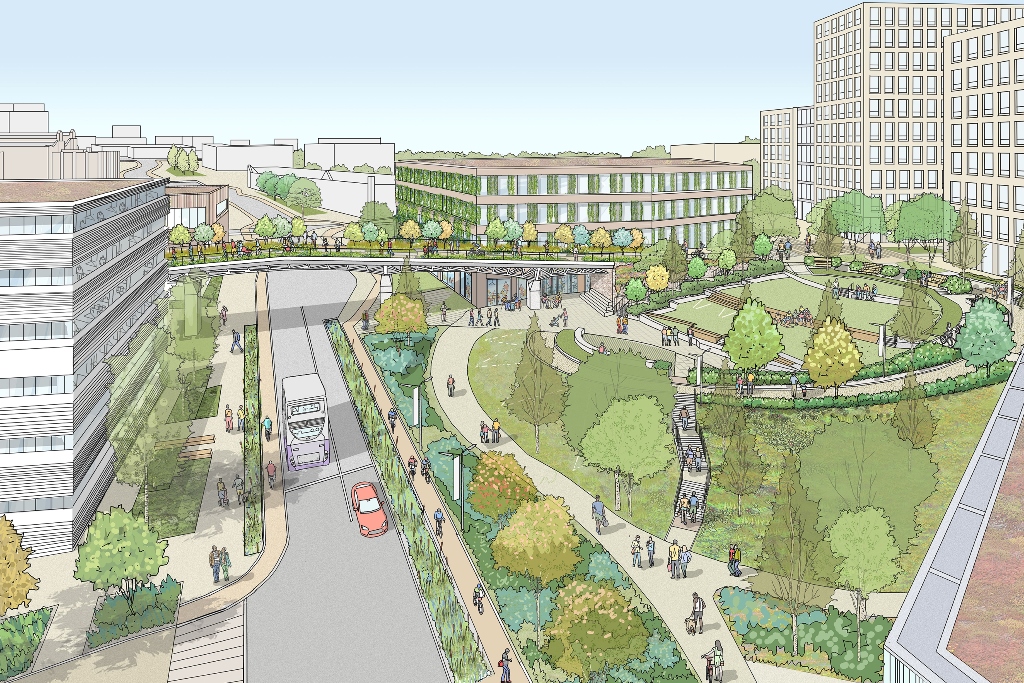
The Salford City Council’s approval of Crescent Innovation is a milestone in the expansive £2.5 billion Crescent Salford masterplan. This ambitious scheme, spanning 252 acres, is set to redefine the area’s landscape with its significant infrastructural developments. The approved plan includes 933 new homes and an impressive 1.7 million square feet of space dedicated to commercial, innovation, academic, and research activities. Additionally, the development boasts ‘active ground-floor space’ and a ‘new movement hub,’ designed to invigorate and connect the community.
The Crescent Innovation project is a collaborative effort driven by the Crescent partnership, which consists of Salford City Council, the University of Salford, and the English Cities Fund. The partnership unites public and private stakeholders, including Homes England, Legal & General, and Muse, aiming to stimulate economic growth by enhancing connections between academic institutions and the business sector. The design of the project is spearheaded by Make Architects, who will ensure the development meets the high standards expected of such a transformative initiative.
Strategically positioned across 29 acres between Broughton Road East and University Road, the Crescent Innovation will be linked to the larger masterplan through Salford Rise, a five-acre podium traversing Frederick Road. The initiative follows the completion of key facilities such as the North of England Robotics Innovation Centre, the Science, Engineering, and Environment building, and Energy House 2.0. These existing infrastructures serve as a foundation for further development, reflecting the overarching vision of creating a high-calibre innovation environment.
In his comments, Salford city mayor Paul Dennett emphasised the collaborative vision for the Crescent. He stated, ‘With our Crescent partners – ECF and University of Salford – we are pushing ahead with our vision to create world-class research and development facilities that local people and businesses can benefit from. The Crescent Innovation proposals are a key element of the wider vision for the Crescent area and will change the face of the area through the creation of a high-quality innovation environment, where people can achieve their full potential.’
University of Salford’s vice-chancellor Nic Beech echoed this sentiment, highlighting the project’s significance as a ‘major milestone in our shared mission to transform Salford into a global hub for innovation and groundbreaking research.’ Such endorsements from leading figures underscore the anticipated impact of Crescent Innovation, not only as a catalyst for regional economic enhancement but also as a beacon of academic and business integration.
Crescent Innovation is poised to transform Salford into a leading centre for research and development, bolstering both local and regional growth.
