
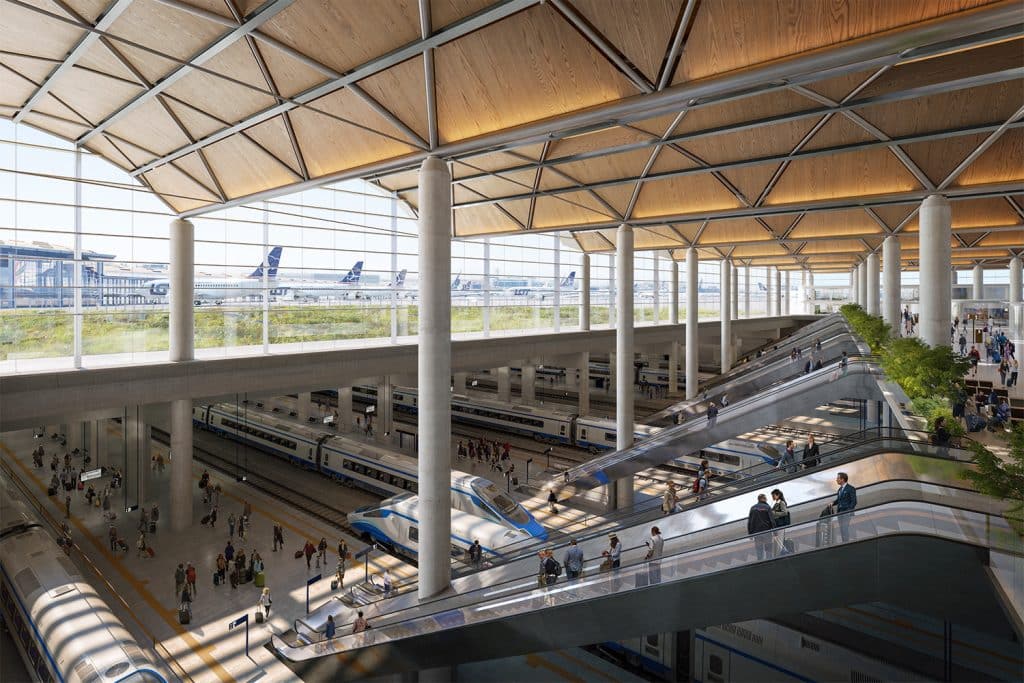

Poland’s new transport hub, Centralny Port Komunikacyjny, is nearing the next phase with its design finalised by an architectural consortium.
- The project, a £25bn investment, will integrate a new airport with rail and bus stations, enhancing regional connectivity.
- Over 1,000 hectares of land have been acquired, with geological work underway, although planning approval is pending.
- Expected to open by 2032, the hub aims to accommodate 68 aircraft and 11,000 passengers per hour initially.
- State-of-the-art designs focus on passenger comfort and efficiency, featuring reduced walking distances and modular waiting areas.
Poland’s ambitious infrastructure project, the Centralny Port Komunikacyjny (CPK), marks a significant milestone with its design now complete. The consortium, featuring renowned firms like Foster + Partners and Buro Happold, has crafted a blueprint that promises to transform regional transport integration. This state-of-the-art development is set approximately 40km west of Warsaw, promising new economic and transit opportunities.
While planning approval is yet to be granted, the project has already seen the acquisition of over 1,000 hectares of land, with geological exploration having started last year. The commencement of construction, currently targeted for 2026, hinges on the project moving through Poland’s bureaucratic processes swiftly and efficiently.
The recently completed terminal design will encompass roughly 45 hectares dedicated to passenger services across three levels. Initially, the facility aims to accommodate 11,000 passengers per hour with 170 check-in and baggage services available, aiming to meet increasing travel demands.
The innovative design integrates comfort and accessibility, with reduced walking distances and improved weather protection. Key features include shorter passenger piers and a distinctive column-supported arcade rather than the initial concept’s overhanging roof. This redesign aids in reducing steel usage while enhancing passenger experience with acoustic and aesthetic improvements.
Foster + Partners, through Grant Brooker, emphasised crafting an intuitive and passenger-friendly infrastructure. The collaboration among over 500 designers has focused on creating a harmonious environment that prioritises efficiency and passenger comfort. The terminal will feature enhanced waiting areas, directly connected to rail services, offering a seamless transfer experience.
The initial phase will introduce a northern pier dedicated to long-haul flights and central piers for flexible Schengen and Non-Schengen travel. The integrated transport system ensures that 50% of passengers can access the hub by train, underscoring the hub’s forward-thinking design in reducing carbon footprints.
Aside from the commercial operations, the CPK project encompasses constructing essential infrastructure such as runways, taxiways, and a full-service air traffic control tower. Additionally, a competitive tender is underway for developing a comprehensive baggage handling system extending over 11km.
Finally, the project’s timeline aligns with the opening of the Warsaw-CPK-Łódź High-Speed Rail line, anticipating a pivotal role in Poland’s transport future. Preliminary works are progressing, paving the way for the hub’s full operation by 2032.
The Centralny Port Komunikacyjny project is set to redefine regional transport, focusing on efficiency and passenger comfort, with its launch aimed for 2032.
