
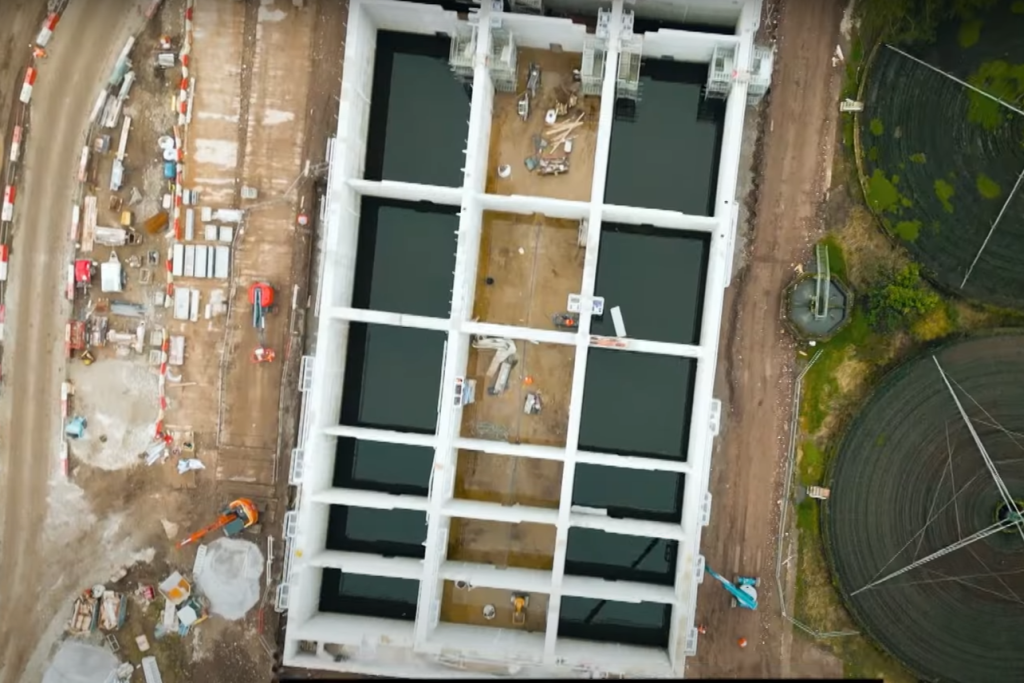

United Utilities has successfully completed a £50M upgrade at Macclesfield wastewater treatment works, inaugurating an innovative MOB tank.
- The MOB tank harnesses renewable plant material to support bacterial growth, offering a more sustainable solution than traditional plastic media.
- This advancement, patented by Nuvoda, marks the first UK utilisation to improve water treatment processes.
- The upgrade addresses the need to reduce phosphorus and ammonia levels, ensuring the facility can handle increased rainfall and population growth.
- Construction involved a substantial mobilisation of resources, completing in just over a year with precise engineering techniques.
United Utilities has marked a significant milestone with the completion of a £50M upgrade at the Macclesfield wastewater treatment facility. The centrepiece of this development is the innovative Mobile Organic Biofilm (MOB) tank, which employs renewable plant materials to support the bacteria essential for wastewater treatment. This advancement provides a more sustainable alternative to the commonly used plastic media, reducing environmental impact while improving treatment efficacy.
The MOB technology, patented by Nuvoda, is being utilised for the first time in the UK. The implementation at the Macclesfield site aims to lower phosphorus and ammonia levels in the water, a crucial step in safeguarding local waterways, particularly during heavy rainfall events. These enhancements are designed to future-proof the facility against the expected increase in population in the area.
Strategically located at Prestbury, the Macclesfield wastewater treatment works discharge into the River Bollin, a significant tributary of the River Mersey. United Utilities’ decision to integrate this cutting-edge technology involved a delicate balance of upgrading existing operations without disrupting current service delivery to the surrounding community.
Examining the engineering feat, the MOB tank spans a volume of 11,700m3, with dimensions of 65m by 32m. Its construction featured the use of 4,393m3 of concrete and 1,047 tonnes of reinforcement, laid out in three treatment lanes with seven cells each, alongside a high-level distribution chamber. The precise completion of these components, tested through rigorous aeration grid checks, underscores the project’s success.
This project represents a collaborative effort, with C2V, a joint venture between VolkerStevin and Jacobs, spearheading the construction. Their partnership with Offa-fix Formwork ensured timely and efficient completion within a year. Such coordination exemplifies a concerted effort towards advancing environmental infrastructure and innovation.
The completion of the MOB tank in Macclesfield signifies a forward-thinking approach in water management, ensuring future resilience.
