
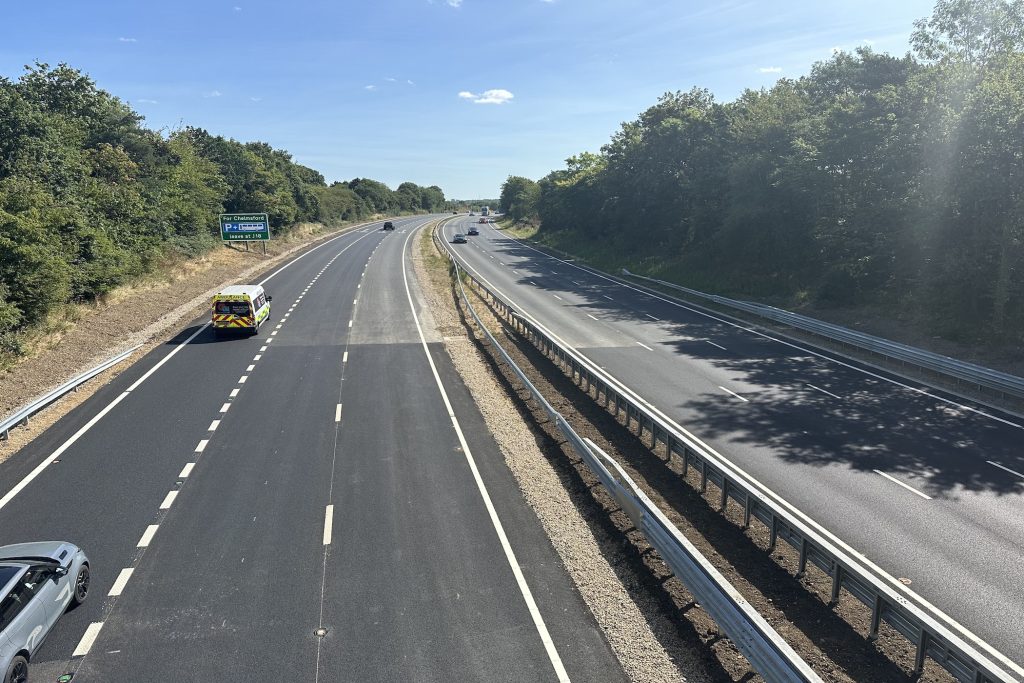

The £75M concrete replacement scheme on the A12 Margaretting Bypass has concluded successfully, marking a significant milestone for infrastructure in Essex.
- The major reconstruction project commenced in February 2023 and involved the replacement of the aging concrete surface with asphalt to reduce noise and maintenance.
- Over 58,000 tonnes of asphalt were utilised, with innovative strategies implemented to achieve a 58% reduction in CO2 emissions.
- Considerable efforts were made to ensure continuous traffic flow during the reconstruction, addressing the geometric challenges of the three-lane carriageway.
- National Highways’ overarching programme aims to revitalise concrete roads across England, with the A12 project setting a benchmark for future initiatives.
The completion of the £75M A12 Margaretting Bypass reconstruction represents a critical advance in improving road infrastructure in Essex. This project, initiated by National Highways and Morgan Sindall Infrastructure, sought to address the deteriorating condition of the existing concrete road, which had reached the end of its serviceable life. The reconstruction began in February 2023, replacing the outdated concrete surface between junctions 13 and 15 with a new asphalt one. This change was primarily aimed at reducing vehicle noise and lowering maintenance requirements, thereby extending the road’s serviceable life to an estimated 40-50 years.
In total, approximately 58,000 tonnes of asphalt were laid as part of this ambitious reconstruction project. In line with contemporary environmental goals, the scheme integrated several pioneering methods to curtail its carbon footprint by an impressive 58%. Key measures included recycling the existing concrete and base materials, which alone led to a saving of 106.8 tonnes of carbon. Moreover, by reducing the surfacing thickness, the project managed to save around 17,000 tonnes of carbon emissions in total.
Continuity of traffic flow was a paramount consideration during the project’s execution, given the road’s importance for linking major towns such as Colchester and Chelmsford. Morgan Sindall’s project manager, Robert Colthorpe, highlighted the difficulty of maintaining two operational lanes on a three-lane carriageway, noting the geometric challenges involved. Considerable effort was therefore invested in configuring a temporary but functional layout that allowed construction activities to proceed efficiently without causing significant disruption.
The A12 initiative is part of a broader strategy spearheaded by National Highways to rejuvenate old concrete roads throughout the UK. The programme involves a sweeping £400M investment from 2020 to 2025 to either repair or completely reconstruct these surfaces. Such roads, primarily constructed in the 1960s and 1970s, now make up about 4% of England’s motorway and major A-road networks. The Margaretting Bypass project is particularly noteworthy as it serves as a pioneering model for comprehensive concrete carriageway reconstruction.
National Highways head of planning and development, Simon Amor, referred to the project as “a bit of a trail finder programme” as it provided invaluable lessons in handling complex roadside infrastructure tasks. The agency has affirmed that insights gained, particularly about carbon reduction and innovative construction techniques, will be shared within the organisation and beyond to guide future projects.
The reconstruction of the A12 Margaretting Bypass is a testament to innovative engineering and a crucial step toward modernising the UK’s infrastructure.
