
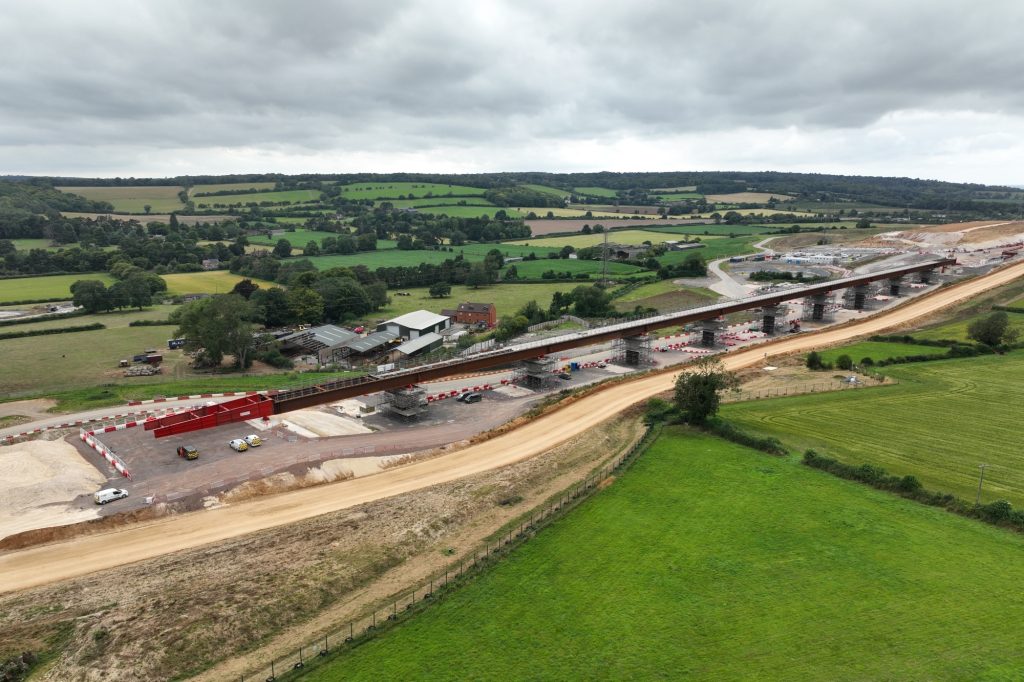

The completion of the 450m deck slide on the Wendover Dean Viaduct marks a pivotal moment for HS2 construction.
- The process took eight months, gradually increasing the deck’s weight from 590t to 3,700t.
- Teflon pads were crucial for reducing friction during the deck’s slide over concrete piers.
- The deck’s final positioning involves a 600mm descent onto permanent bearings, a process expected to last two months.
- Innovative double composite beams reduce carbon footprint, setting a new standard for future projects.
The meticulous eight-month operation to slide the 3,700-tonne deck of the Wendover Dean Viaduct represents a significant accomplishment for the HS2 project team. The operation was carried out in three stages, commencing with a 90m segment in January, followed by a 180m span completed over four days in May. The deck reached its full length on 10 August, positioned over nine concrete piers.
The method employed involved pushing the deck uphill, ensuring meticulous control over its movement while utilising Teflon pads to minimise friction between the deck and temporary steel bearings. With each advancement, the deck’s weight increased substantially, necessitating precision engineering to maintain structural integrity and alignment.
Currently, the steel deck is positioned 1.8m higher than its final intended elevation. The complex task of lowering the deck by 600mm onto permanent bearings is slated to take two months, demanding a careful pier-by-pier reduction of 200mm. Upon completion, the bridge’s concrete infrastructure will be installed, requiring specially designed travelling formwork for efficient construction.
The deck’s innovative design, featuring double composite ‘I’ beams of weathering steel encased within concrete slabs, offers a substantial reduction in carbon emissions compared to conventional methods. This environmentally-conscious approach aligns with broader sustainability goals and is being trialled on four additional viaducts within the HS2 network, including Small Dean and Westbury.
Key project figures, such as Nicola Henderson-Reid and James Collings, have acknowledged the remarkable teamwork and dedication that has been instrumental in achieving this milestone. Their focus remains on the upcoming challenges, notably the careful transition of the viaduct to its permanent bearings, which is essential for the railway’s support.
The successful completion of the deck slide signifies a crucial step forward in the HS2 project, promising enhanced rail connectivity.
