
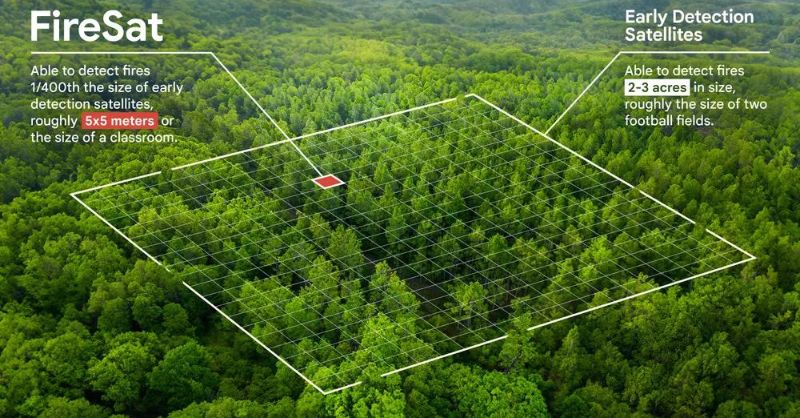

Google’s FireSat, developed with the Earth Fire Alliance, aims to transform wildfire response with advanced satellite technology.
The system promises faster and more accurate detection, crucial for mitigating the impacts of increasingly severe wildfires.
Understanding the Wildfire Crisis
Wildfires are becoming increasingly frequent and severe, with climate change being a major catalyst. Rising global temperatures and extended droughts accelerate fire spread, complicating containment efforts. Current satellite imagery technology often lacks resolution and frequency, hindering timely identification and control of fires.
Chris Van Arsdale of Google Research highlighted the difficulty in identifying fires using satellite imagery due to various false positives, such as glints or smoke. FireSat aims to address this, detecting fires as small as five by five metres, allowing prompt response and potentially preventing extensive damage.
The FireSat Initiative
FireSat is a cutting-edge constellation of satellites specifically designed to detect wildfires. The system utilises advanced infrared sensors, created in partnership with Muon Space and the Environmental Defense Fund. These sensors can pinpoint heat signatures globally every 20 minutes, a significant improvement over existing methods.
FireSat’s real-time, high-resolution capabilities differentiate it from traditional satellite systems, which often sacrifice either detail or update frequency. By offering both, FireSat will enhance emergency response efficacy and resource allocation.
AI Integration in Wildfire Detection
Beyond satellite technology, Google is leveraging its AI expertise to bolster FireSat’s efficiency. Since 2020, AI-driven wildfire boundary alerts have been in use across 20 countries, setting a foundation for more sophisticated fire modelling.
FireSat will aid in long-term fire behaviour analysis, contributing to a comprehensive global record of fire activity. This rich data source will refine firefighting tactics and enhance understanding of fire patterns.
By integrating AI, FireSat not only delivers immediate alerts but also serves as a tool for future predictive modelling, aiding scientists and emergency services in preemptive measures against wildfire threats.
Global Impact on Firefighting Efforts
FireSat promises to revolutionise firefighting by providing precise, real-time data. This capability is crucial for nations with limited wildfire management resources, improving initial response actions and minimising risk.
In areas with existing technology like drones and advanced satellite systems, FireSat will augment current efforts. Michael Wara from Stanford University noted its particular value to less-resourced areas, highlighting its potential as a transformative tool in global fire management.
Addressing the Carbon Footprint
Wildfires significantly contribute to carbon emissions, with Canadian fires in 2023 alone releasing billions of tonnes of CO2. FireSat’s quick detection and response will aid in mitigating these impacts, although combined policy changes are necessary for substantial progress.
Enhanced urban planning and controlled burns are suggested methods to reduce fuel and limit residential vulnerability to wildfires, complementing technology like FireSat.
The Future of Wildfire Management
FireSat embodies a pivotal progression in wildfire management technology. By detecting fires in near real-time, it aims to reduce the widespread destruction associated with uncontrolled wildfires.
While the initial satellite launch is set for 2025, full deployment will take several years. Once operational, FireSat is poised to provide invaluable data to emergency responders and researchers.
As climate challenges persist, FireSat represents an essential tool in global efforts to manage and mitigate wildfire threats, promising improved safety and a deeper understanding of environmental impacts.
Conclusion
FireSat is set to redefine global wildfire management, enhancing detection and response capabilities. Its comprehensive approach promises to significantly improve safety and resource allocation.
FireSat’s innovative approach is crucial for modern wildfire management, improving global response and safety measures.
