
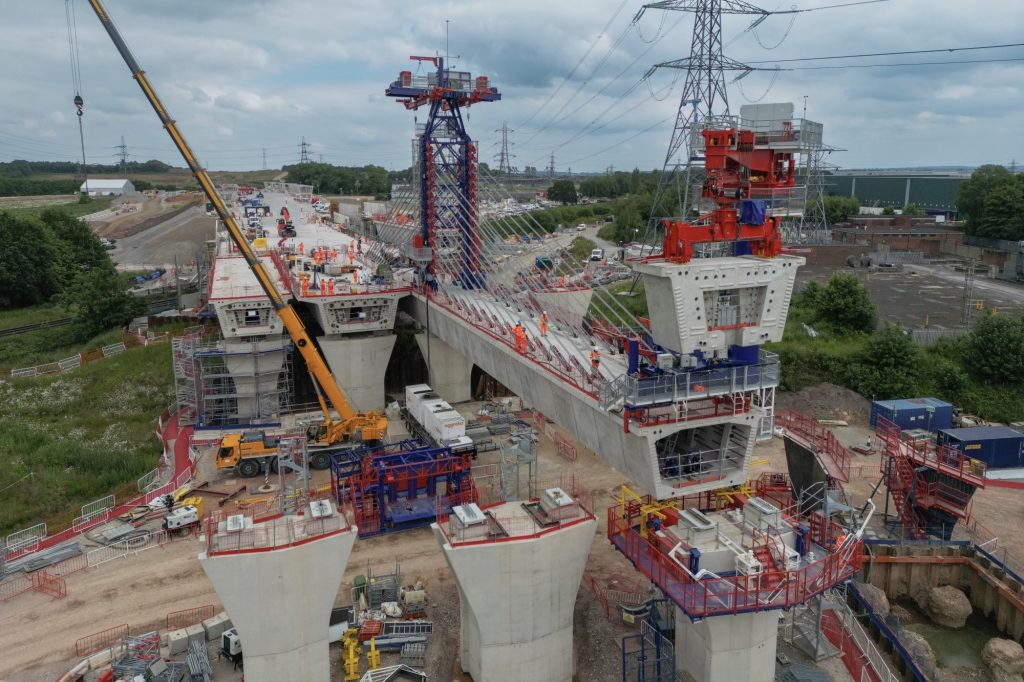

Engineers are pioneering a specialist cantilever process for HS2 in the West Midlands, marking a UK first.
- Construction focuses on a 472m single-track viaduct, part of the complex Delta Junction.
- Builders completed initial three-track sections last spring, utilising innovative engineering techniques.
- The viaduct involves strategic placement and securing of 2,500 concrete segments.
- Completion of this project phase is anticipated for August 2026, employing advanced construction strategies.
In a significant milestone for UK engineering, a team from Balfour Beatty Vinci JV is implementing a specialist cantilever construction method for the first time. This marks a pivotal development in the construction of the High Speed 2 (HS2) railway in the West Midlands. The project centres around a 472-metre viaduct, designed to enhance connectivity on the HS2 network, specifically within the Delta Junction complex on Birmingham’s outskirts.
This ambitious undertaking began with constructing the viaduct’s 20 piers, initiated last year. By spring 2024, the first spans of the three-track section were successfully completed. The construction involves a meticulous process where segments are placed on 42-metre truss beams and moved using a skidding trolley, subsequently secured by post-tensioning techniques. Once this initial phase was concluded, work on the vast cantilever structure commenced.
The construction of the giant cantilever structure presents an intricate process involving a 22-metre high mast with temporary post-tensioning cable stays and a 14-metre high swivel crane. This crane is responsible for lifting and installing each concrete segment successively until the span achieves its full 45-metre length. Post-tensioning tendons are stressed, leaving the permanent structure secure as temporary stays are removed.
Throughout this process, a total of 2,500 concrete segments will be strategically placed, with project completion aimed for August 2026. This pioneering approach will also be applied to nine additional viaducts within the Delta Junction, demonstrating the scalability and effectiveness of this innovative method.
The origin of this technique traces back to engineer Campenon Bernard, now part of Vinci Construction, while the swivel crane was designed by Berd. A notable aspect is the use of precast concrete segments, each uniquely precise to fit with minimal adjustments. This is achieved through a match-casting technique, ensuring each segment seamlessly aligns with the previous one, maintaining structural integrity when assembled on site. These segments are produced at HS2’s facility in Lea Marston, and the design is a collaborative effort by Mott MacDonald and Systra Design Joint Venture.
A key highlight of this project is the collaboration and innovation demonstrated by all parties involved. Notably, BBV engineer Nicolas Gallone expressed the importance of this endeavour, describing it as a ‘significant moment’ for the contractor. The post-tensioning technology implemented, which is a pioneering effort by Vinci, is set to tackle engineering challenges such as existing waterways and utility systems efficiently, thus marking a crucial achievement in UK civil engineering. Similarly, MMSDJV’s project director Ian Johnson praised this milestone, emphasising the combination of innovation, collaboration, and dedication in reaching this stage.
Sam Hinkley, leading the HS2 project for Delta Junction, acknowledged the collective effort that facilitated the realisation of this UK-first accomplishment. He highlighted the collaborative innovation from designers, the civil contractor, and the broader supply chain in delivering this exceptional engineering feat.
This landmark engineering project not only represents a significant achievement for the HS2 network but also sets a new standard for future infrastructure developments.

