
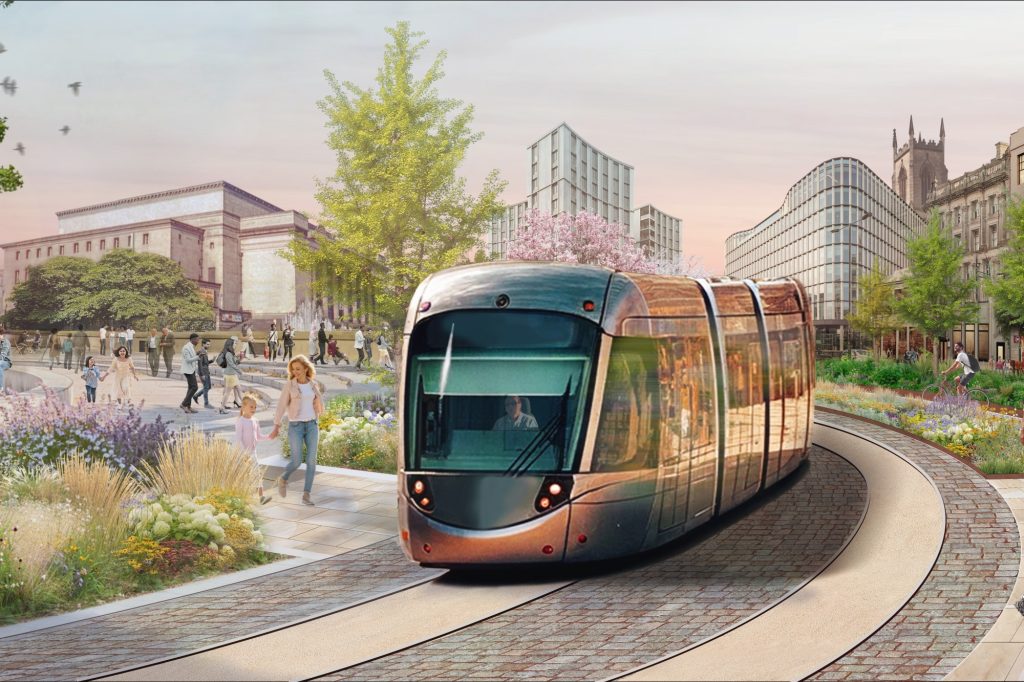

The West Yorkshire Combined Authority (WYCA) has initiated an 11-week public consultation on the proposed £2.5bn tram network to connect Leeds and Bradford.
- Four route options are available for the Leeds line, with varying connections to significant areas such as the White Rose shopping centre and Leeds United’s Elland Road stadium.
- Three potential routes for the Bradford line aim to enhance connectivity between Bradford and Leeds city centres, servicing additional communities.
- Future statutory consultations in 2025 will develop these proposals further, involving plans for tram stops, depots, and park and ride sites.
- The anticipated development timeline suggests construction beginning in 2028, with initial operations expected in the early 2030s.
The West Yorkshire Combined Authority (WYCA) has announced the beginning of an 11-week public consultation process to gather feedback on a proposed major tram network, valued at £2.5bn, aimed at connecting the urban centres of Leeds and Bradford. This initiative underscores the importance placed on public opinion in shaping the future trajectory of the city’s transportation infrastructure.
The proposed Leeds line comprises four potential routes, each providing unique benefits. All options offer proximity to key city destinations such as the White Rose shopping centre, with two routes explicitly extending services to Leeds United’s renowned Elland Road stadium. In addition, these routes are designed to improve access to critical sites like Leeds General Infirmary, The South Bank, Holbeck, and Beeston.
Similarly, the Bradford line features three route possibilities that focus on linking Bradford and Leeds city centres. These routes aim to enhance travel options for residents, traversing neighbourhoods such as Thornbury, Laisterdyke, Pudsey, Armley, and Wortley, thus expanding the commuter and logistical landscape of the region.
WYCA has indicated that once preferred routes are selected and refined, more comprehensive public consultations will follow in 2025. At this stage, detailed proposals will emerge, outlining the design and location of tram stops, depots, and park and ride facilities. The legal framework to commence construction, sought through a Transport Works Act Order, is projected for submission in 2026, with construction slated for a 2028 start.
Engagement with local councils such as Kirklees, Calderdale, and Wakefield is ongoing, ensuring collaborative planning for subsequent transit phases. This inclusive approach aspires to guarantee equitable transit improvements across West Yorkshire, leaving no community marginalised.
Leaders from across the region, including West Yorkshire Mayor Tracy Brabin and WYCA transport committee chair Susan Hinchcliffe, have vocalised their optimism. They emphasize the pivotal role of this mass transit system in fuelling economic growth, enhancing regional connectivity, and fostering community welfare.
James Lewis, leader of Leeds City Council, highlights the transformative potential of this transit system, describing it as crucial for delivering inclusive growth and stimulating further investment into the city.
Sir John Armitt, chair of the National Infrastructure Commission, supports the initiative, acknowledging its significant potential to revitalise public transport in West Yorkshire, reduce congestion, and stimulate sustainable economic growth.
The proposed Leeds-Bradford tram network is positioned to significantly transform regional connectivity and economic prosperity.
