

Efforts to enhance flood defences in East Sussex continue to advance with innovative approaches.
- Key upgrades are focused on the eastern bank of the River Rother, aiming to mitigate flood risks to homes and businesses.
- VolkerStevin is leading the project, incorporating advanced technologies to navigate site constraints effectively.
- Innovative engineering solutions are critical, earning the project recognition for technology and carbon reduction contributions.
- The initiative falls under the auspices of the Environment Agency to bolster regional flood resilience.
Efforts to improve flood defences along the eastern bank of the River Rother are progressing with determination. Spearheaded by VolkerStevin, the project is a vital endeavour intended to mitigate coastal flood risks threatening homes and businesses in the area. By raising existing embankments, refurbishing the Union Channel, and constructing new flood defence walls, the project aims to solidify the resilience of the region against future flooding events.
Currently, earthworks across the site are advancing rapidly, with excavation phases concluded and clay importation completed. The construction activities are taking place in both northern and southern parts of the site, with particular focus on structural works at the Union Pumping Station. Here, existing flood walls have been demolished, making way for four newly erected walls that are notably taller and built with substantial foundations to bear greater water loads.
The new flood defence walls, composed of reinforced concrete, rest upon sheet piles stretching 7.5 metres deep, securely installed by VolkerGround Engineering. The project’s deployment of 358 steel sheet piles, each 4.7 metres long, along a 240-metre segment of the embankment during April and May 2024, underscores the extensive efforts undertaken to fortify the flood barriers.
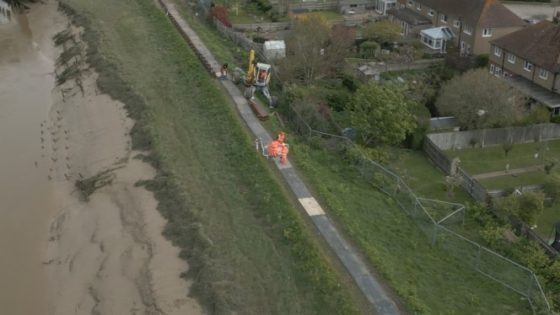
VolkerStevin creatively addressed unique site challenges, particularly the restricted access in segments of the embankment that narrow to merely 2.5 metres. Innovative methods, such as using a spider excavator with an auger dangle drill, have facilitated pre-augering the pile line to circumnavigate obstructions, exemplifying the ingenuity applied to ensure project progression despite difficult conditions.
Considerable logistic challenges were faced, including the necessity for piles to be transported using wagons instead of articulated trailers due to narrow site entrances. To support this, piles were relocated within the site using a battery-operated, radio-controlled tracked carrier traversing track mats laid on the embankment. Such approaches have not only solved logistical hurdles but also contributed to notable CO2 savings, making a case for the project’s inclusion in the TechFest 2024 Awards.
The East Sussex coastal flood defence project exemplifies strategic innovation in civil engineering, ensuring enhanced resilience against coastal flooding.
