
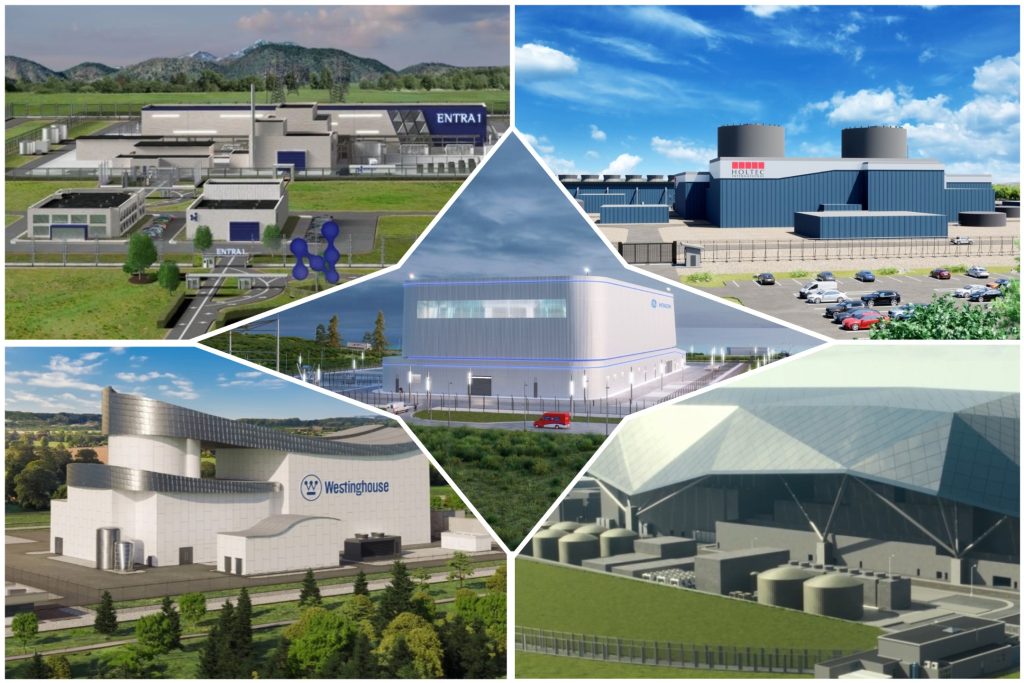

This week saw significant progress in the Great British Nuclear competition as five out of six shortlisted firms submitted their initial tenders for small modular reactors (SMRs).
- GE-Hitachi, Holtec Britain, NuScale Power, Rolls-Royce SMR, and Westinghouse Electric Co all met the extended deadline to submit proposals.
- Small Modular Reactors (SMRs) are poised to transform the nuclear energy sector, offering faster and cheaper deployment.
- Despite its promising design, EDF withdrew from the competition to focus on alternative projects, maintaining commitment to UK nuclear development.
- Each bidder has presented a unique technological advancement with potential benefits for the UK’s energy security and economic growth.
The Great British Nuclear competition, aimed at rolling out small modular reactors (SMRs) in the UK, has seen promising submissions from five of the six shortlisted firms. These firms—GE-Hitachi, Holtec Britain, NuScale Power, Rolls-Royce SMR, and Westinghouse Electric Co—have met the post-election deadline, pushing forward the initiative for a decarbonised power network.
GE-Hitachi has proposed its BWRX-300, a 10th generation SMR leveraging decades of technological experience. The company highlights its boiling water reactor technology’s simplicity and cost-effectiveness as key assets in delivering value. According to Andy Champ, GE-Hitachi UK’s country leader, their strategic partnerships enhance their capability to assist the UK Government in achieving net zero goals by 2050.
Holtec Britain, in collaboration with Hyundai Engineering and Construction and Mott MacDonald, entered its SMR-300 using pressurised water reactor (PWR) technology, a familiar design in the UK. Holtec emphasises its intent to use modular construction methods and views its role as critical for UK energy security, even exploring site locations for a potential SMR manufacturing facility in England.
NuScale Power has teamed with ENTRA1 to offer a solution noted for rigorous research, regulatory approvals, and the commencement of module manufacturing. NuScale positions its SMR offering as a dependable carbon-free energy solution without extensive public financial support, underlining its readiness for deployment across the UK.
Rolls-Royce SMR, advancing with a 470MW reactor design, has crossed important developmental benchmarks and plans to build a manufacturing and testing facility at the University of Sheffield. The company expresses eagerness to rapidly progress to the competition’s next phase, signalling strong commitment to the SMR development.
Westinghouse’s AP300, an evolution of its AP1000 reactor, claims a robust supply chain foundation as a strategic fit for the UK’s energy ambitions. Rita Baranwal, senior vice president, assures that their proven technology will not only meet GBN’s objectives but also solidify a long-term, sustainable energy partnership.
Contrastingly, EDF chose to withdraw its NUWARD SMR proposal despite completing basic design stages. The firm remains dedicated to supporting the UK’s nuclear sector, particularly by extending the lifespan of existing plants and advancing projects at Hinkley, Sizewell, and Wylfa.
The submissions mark a pivotal step in the UK’s nuclear strategy, with diverse SMR technologies poised to bolster the nation’s energy future.

