
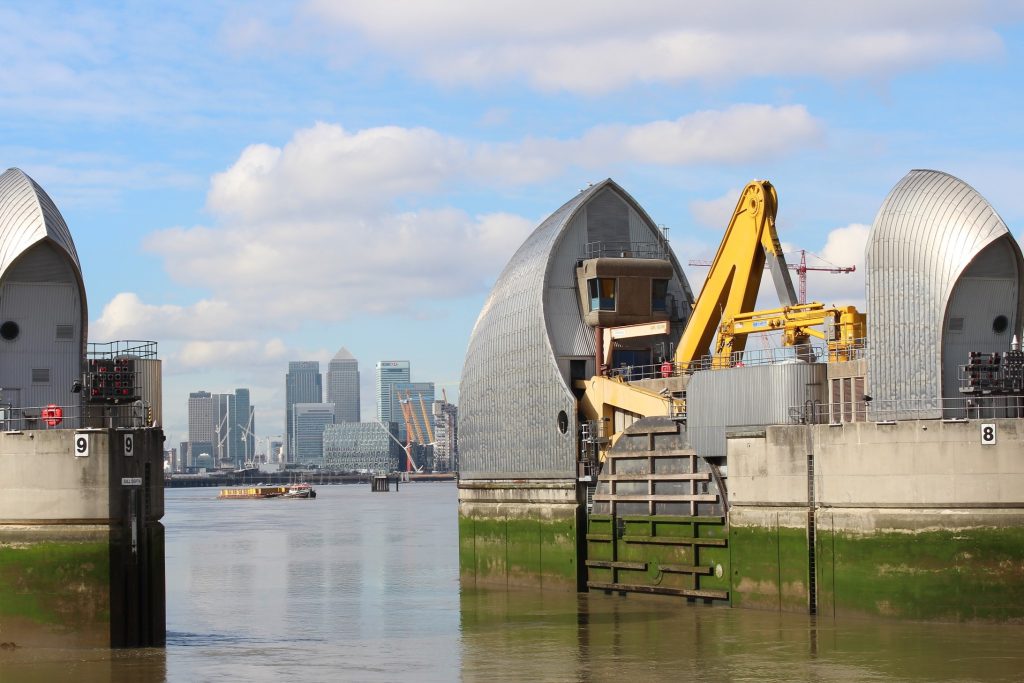

The Thames Barrier marks 40 years of protecting London from floods, operational since 1982.
- Queen Elizabeth II inaugurated the Thames Barrier on 8 May 1984, a crucial infrastructure piece.
- Since 1983, the barrier has operated 221 times, vital against tidal surges from the North Sea.
- Originally designed for a lifespan until 2030, its operational life now extends to 2070.
- Future plans include enhancing defences and considering new barriers to maintain London’s flood protection.
The Thames Barrier, initially operational in 1982 and officially opened by Queen Elizabeth II on 8 May 1984, stands as a monumental feat in engineering, erected to shield London from the formidable tidal surges originating from the North Sea. Since its first closure in 1983, the barrier has been activated 221 times, safeguarding the capital against potentially devastating floods. These operations have been pivotal, with 150 occurring before the 2013/2014 period alone.
This engineering marvel, located between Charlton and Silvertown, arose from the catastrophic floods of 1953 which claimed 300 lives. Following Sir Hermann Bondi’s 1966 report, the decision was made to construct the barrier near Woolwich. The strategy was to utilize this straight, wide, and deep river stretch to facilitate naval navigation while enhancing downstream embankments.
An extensive maintenance regime is critical to the barrier’s reliability. Andy Batchelor, who began working on the day it opened and retired on its 40th anniversary, led a team dedicated to its upkeep. Emphasising the importance of maintenance, Batchelor highlighted the necessity for regular checks and the adaptability of the team in operations. His insights reflect the importance of continuous, expert-led maintenance to ensure the barrier’s operational integrity.
Functionally, the barrier comprises ten steel gates, each rising to the height of a five-storey building and weighing 3,300 tonnes. These gates deploy based on analyses of tide height, tidal surge levels, and river flow at Teddington Weir. The barrier cost £535 million to build over eight years, roughly £2.4 billion in today’s money.
While originally designed for a lifespan up to 2030, technological advancements and robust construction have extended its life expectancy to 2070. However, projections from the Thames Estuary 2100 team indicate the need for substantial defences enhancement by 2040. This foresight aligns with predictions of a significant sea-level rise, necessitating strategic planning to prolong the barrier’s life and reduce its closure frequency.
Dave Cuthbertson from the TE2100 team remarks on the ongoing efforts to bolster defences, which include raising inner estuary walls to cut down barrier closures. He emphasises the need for cost-efficient flood risk management and outlines potential future actions: upgrading existing barriers, constructing new ones, creating flood storage areas, or implementing barriers with locks.
The Environment Agency’s meticulous planning will ensure London’s continued protection from tidal threats through to 2070 and beyond, with long-term decisions targeted by 2040 to preempt evolving climate challenges.
The Thames Barrier remains a critical asset, with plans ensuring its role in London’s flood defence for decades.

